
Reading time: 3 minutes
For the built environment, this marks a fundamental shift. Buildings are no longer operating within stable, predictable systems. Instead, they are embedded in dynamic networks of energy, data, supply chains, and urban infrastructure, where disruption in one domain can rapidly propagate to others. The United Nations Office for Disaster Risk Reduction emphasizes that disaster risk is now largely systemic, requiring resilience strategies that explicitly address interdependencies between critical infrastructures.
In this context, resilience can no longer be understood as structural robustness alone. The central question is not whether a building can withstand disruption, but whether it can continue operating within unstable, interconnected systems. This is where connectivity becomes decisive.
From Efficiency to Continuity
For decades, building technology has been defined by efficiency. However, in a polycrisis context, this logic becomes insufficient. Efficiency assumes stability. It optimizes for normal operation, but does not ensure performance when systems are disrupted. The International Energy Agency highlights that digitalisation in the energy and buildings sector is no longer driven by efficiency gains alone, but increasingly by the need for flexibility and resilience under changing conditions.
As infrastructures become more interconnected, the nature of risk changes. Disruptions no longer remain isolated. Disruptions can propagate across energy, mobility, and communication systems simultaneously. The World Bank emphasizes that such cascading effects redefine infrastructure risk, making resilience dependent on the ability of systems to respond dynamically rather than operate efficiently.
In this environment, the objective shifts from optimization to continuity. Buildings must maintain essential functions not only under normal conditions, but also during disruption. This requires systems that can detect anomalies, communicate across infrastructures, and coordinate responses in real time. Connectivity, therefore, is not an enhancement of efficiency. It is the precondition for continuity.
Connectivity as Operational Infrastructure
Preparing buildings for polycrisis conditions requires a fundamental reframing of connectivity. It can no longer be understood as a feature layer added to building systems. It must be treated as an operational infrastructure that links buildings to wider energy, mobility, and emergency networks.
In highly interconnected environments, resilience is determined by coordination. Buildings must be able to exchange data across external systems. Research on systemic risk shows that infrastructures capable of cross-sector coordination recover faster and maintain functionality longer during disruption.
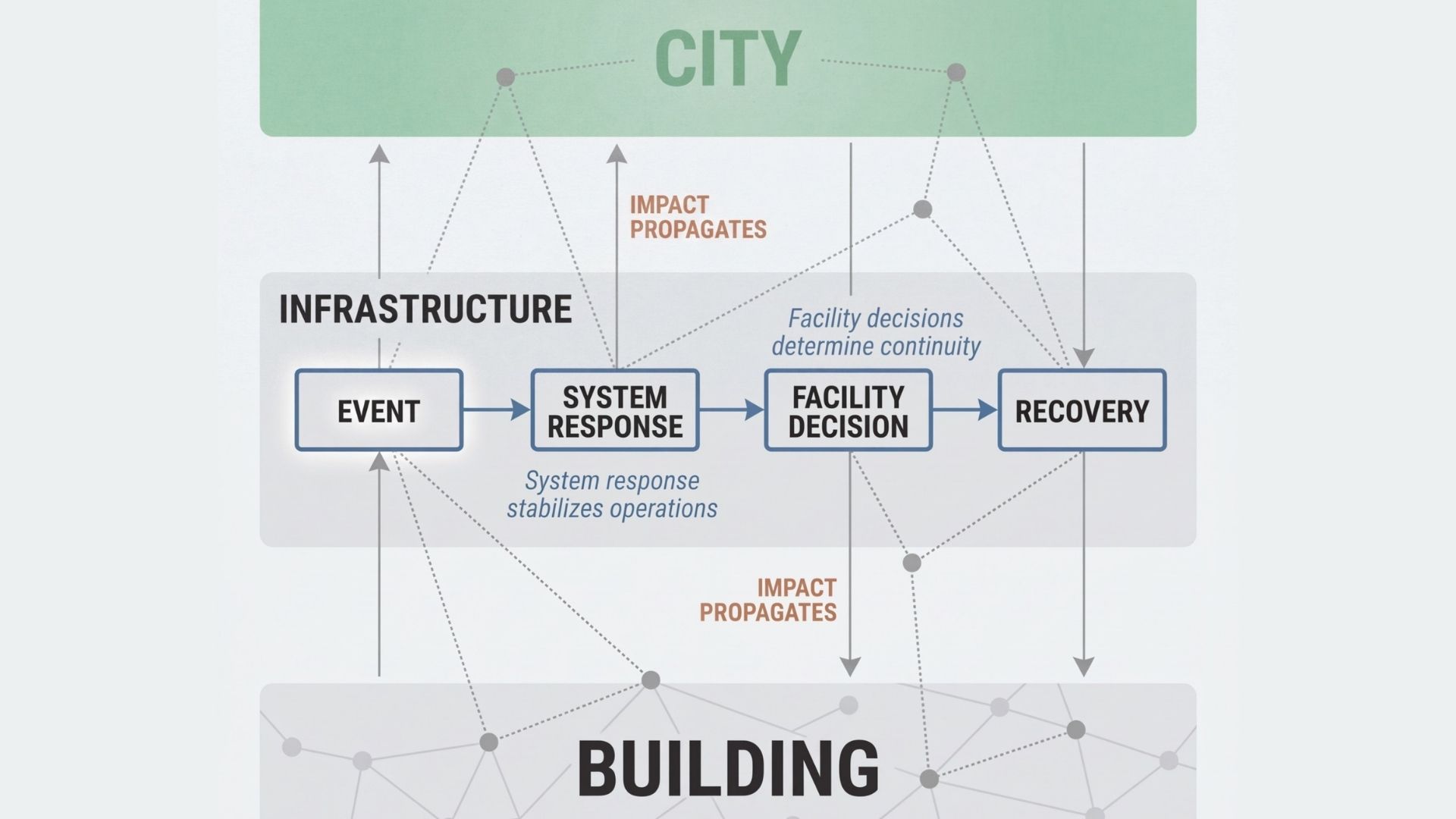
At the building level, connectivity enables continuous situational awareness. Technical systems such as HVAC, power supply, access control, and indoor environmental monitoring can be observed in real time, allowing operators to detect anomalies early and stabilize operations before failures escalate.
At the infrastructure level, connectivity enables responsiveness. Buildings can react to external signals, for example, by reducing energy demand during grid stress or adapting operation during extreme weather conditions. The International Energy Agency highlights that digital control and demand-side flexibility in buildings are essential for maintaining stability in increasingly volatile energy systems.
At the urban scale, connectivity transforms buildings from passive assets into active components of resilience. Building-level data can support emergency response, resource allocation, and public safety coordination, particularly in dense urban environments where disruptions propagate rapidly. The United Nations Office for Disaster Risk Reduction emphasizes that resilient cities depend on integrated information flows between buildings, infrastructure operators, and public authorities.
Seen in this way, connectivity creates a hierarchy of resilience: from sensors to systems, from systems to infrastructure, and from infrastructure to citywide coordination. Buildings prepared for polycrisis conditions must operate across all of these layers simultaneously. Without this multi-layer connectivity, resilience remains partial.
Designing Buildings for Polycrisis Conditions
Designing buildings for polycrisis conditions requires moving beyond fixed assumptions. They must be able to operate under continuous uncertainty, where disruptions are not exceptions but recurring conditions.
This shift redefines resilience as an operational capability. The World Bank defines resilient infrastructure as systems that can absorb shocks, continue operating during disruption, and recover quickly after failure, emphasizing that resilience must be embedded at the design stage rather than added later.
Three design principles become critical: adaptability, redundancy, and operational continuity.
Adaptability ensures that buildings can adjust to changing conditions without structural intervention. Energy supply fluctuations, shifting occupancy patterns, and increasing climate stress require systems that can evolve in real time. Modular installation technologies, interoperable platforms, and scalable digital controls enable buildings to respond dynamically rather than remain fixed. The European Commission highlights that climate-resilient buildings must be designed to cope with rising temperatures, flooding, and extreme weather across diverse environments.
Redundancy addresses the reality of simultaneous system failures. Polycrisis conditions often disrupt multiple infrastructures at once, making reliance on single systems a critical vulnerability. Backup energy sources, alternative communication pathways, and decentralized control strategies ensure that buildings can maintain operation even when primary systems fail. Research on critical infrastructure resilience shows that diversification and redundancy significantly reduce cascading risks in interconnected systems.
Operational continuity extends resilience to the user level. Buildings must maintain safe indoor conditions during disruption, including heating, cooling, ventilation, and water supply during disruption. The Intergovernmental Panel on Climate Change emphasizes that climate adaptation in the built environment depends not only on structural robustness but also on operational and management strategies that sustain performance under changing environmental conditions.
Rethinking Buildings for Polycrisis Conditions
Resilience can no longer be defined within the boundaries of a single building. It emerges from the interaction between buildings, infrastructures, and institutional systems.
In this context, connectivity becomes a core operational layer. It enables buildings to monitor conditions, coordinate across systems, and respond adaptively in real time. Buildings that can sense, communicate, and adjust dynamically maintain continuity under disruption.
Designing for polycrisis means designing buildings not as isolated objects, but as connected systems embedded within a broader network of infrastructures, institutions, and users.