Get a quick and up-to-date overview of the developments in the field of intelligent building technology. The content is customizable to your interests, presented in a neutral manner, and created by experts for experts.
How smart buildings are becoming the basis for a scalable energy ecosystem with structured data models
The Smart Building Real-World Lab – Research from an Industry Perspective
9 Apr 2026
For smart city concepts, sustainable districts and scalable energy ecosystems, the individual building becomes the decisive key factor as the smallest unit in the overall system.
Scalability and sustainability at the district level can only be achieved if the data basis is already interoperable, structured and manufacturer-neutral at the building level.
From a system-driven to a data-driven approach
In classic building operations, different solutions are used for different use cases, often without any connection to each other. In some cases, platforms are used that are not even intended for the respective use case. Maintenance, for example, is often handled via an ERP system, although this is primarily designed for commercial processes. There are selective interfaces between individual systems. However, these remain isolated solutions that are neither scalable nor enable the targeted and scalable use of AI in operational processes.
The necessary paradigm shift: no longer thinking from the system's point of view, but process-oriented and data-driven. What data is available and what use cases do they need? A sensor that has been installed for a specific use case can thus also be used for other processes. Instead of isolated individual solutions, an ecosystem is created in which data is used multiple times and use cases are thought of across systems.
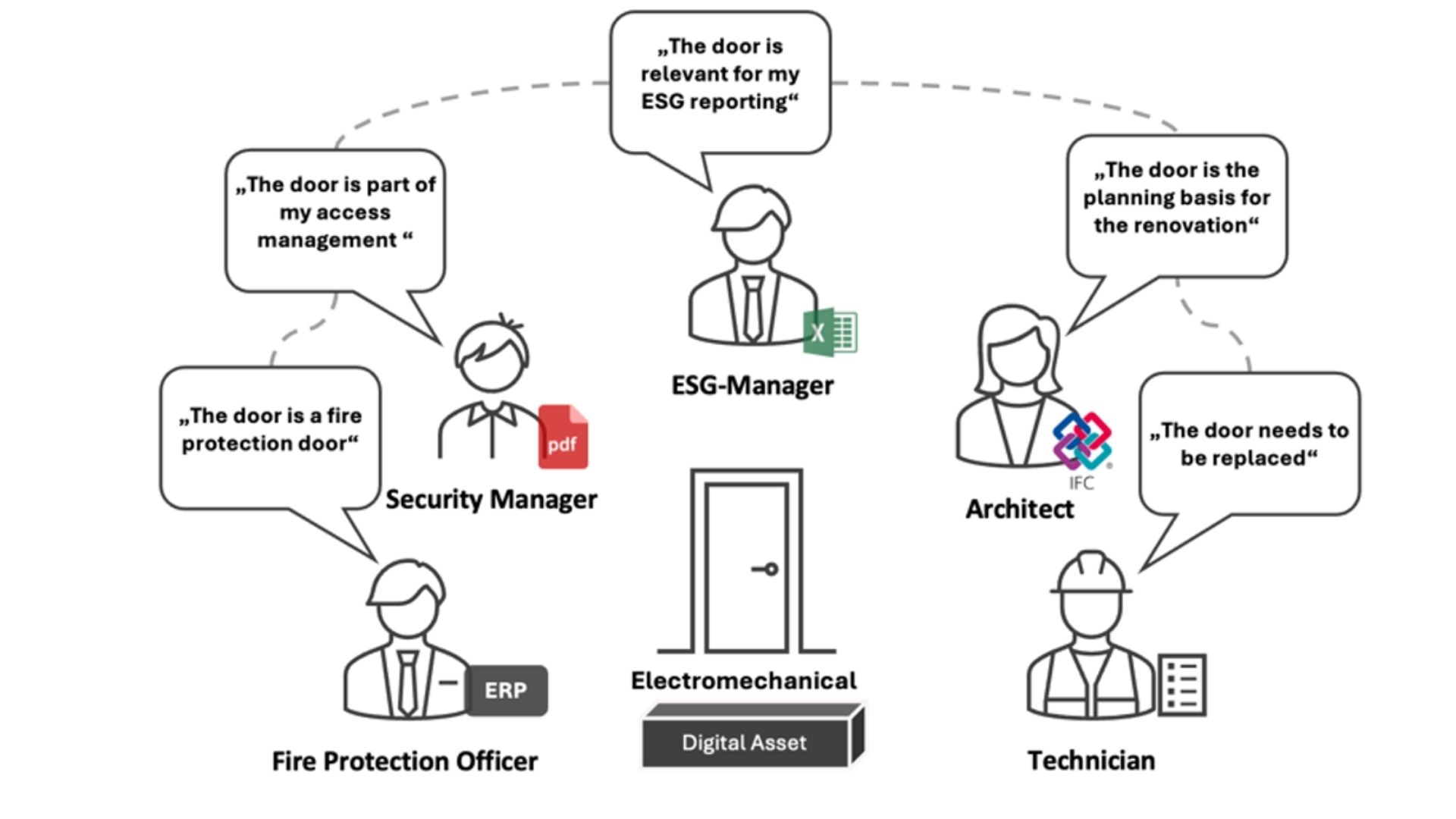
The example of a motorized door (Fig. 1) illustrates today's fragmentation: one and the same asset is viewed completely differently depending on the discipline, recorded in different systems and stored in its own data structures. It exists in numerous systems without the information being linked to each other. What is missing is a uniform data model that brings together all perspectives and serves as a common basis for all processes in building operation.
Fig. 1: Different perspectives on an asset. Depending on the discipline, an motorized door is detected in different systems with different data structures (Image rights: Schröder, Naethbohm)
Fig. 1: Different perspectives on an asset. Depending on the discipline, an motorized door is detected in different systems with different data structures (Image rights: Schröder, Naethbohm)
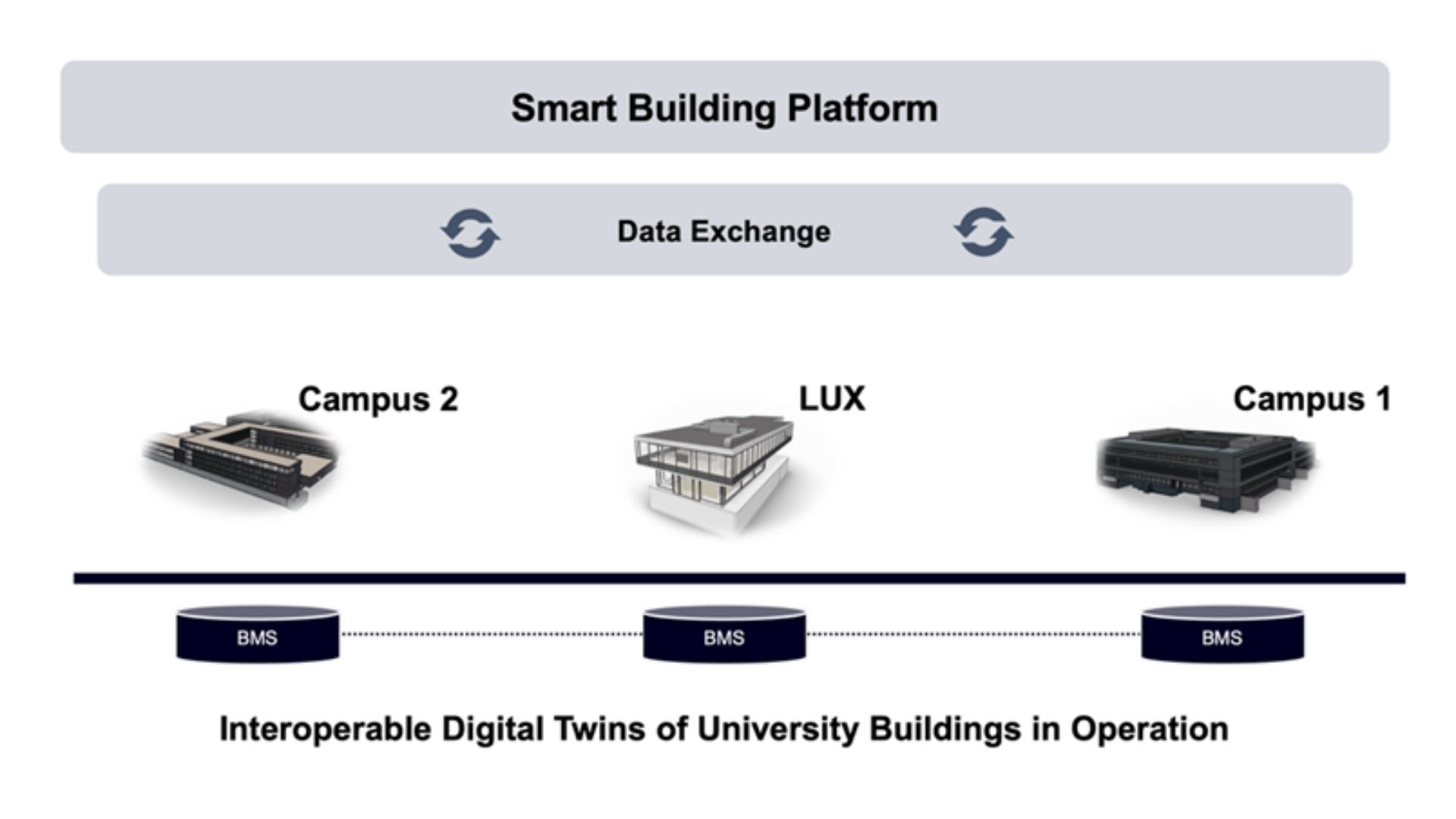
This is where the Smart Building Real-World Lab at Mainz University of Applied Sciences comes in. Instead of storing data in a system-bound and isolated manner, buildings are mapped as interoperable digital twins (Fig. 2). The focus is on the Asset Administration Shell (AAS) of the Industrial Digital Twin Association (IDTA), which enables a uniform exchange of information at the asset level. Each asset is structured and semantically linked to other assets, rooms, systems, processes and other domains according to linked data principles. Crucially, no new standard will be created. Existing standards and ontologies such as RealEstateCore, Brick Schema, ASHRAE 223 or IFC are linked with each other and made usable for the respective use cases.
Fig. 2: Interoperable digital twins of the university buildings in operation. Three campus buildings will be networked via a common smart building platform (Image rights: Smart Building Real-World Lab Mainz University of Applied Sciences)
Fig. 2: Interoperable digital twins of the university buildings in operation. Three campus buildings will be networked via a common smart building platform (Image rights: Smart Building Real-World Lab Mainz University of Applied Sciences)
To implement this vision, an operator data model is needed that endures regardless of the system operator or the platform used. Because just as it is a matter of course that no building is sold today without statics, it is just as natural that no building should be put into operation in the future without a structured, interoperable data model.
"Just as no building is sold today without statics, no building should go into operation in the future without a structured, interoperable data model."
The operator data model as a basis
Mainz University of Applied Sciences developed the "Building Operation 4.0" concept together with Frank Schröder. He is Director of Efficient Technologies in Corporate Facility Management at Phoenix Contact. The company is a globally active technology group for industrial automation, energy and connection technology, which ensures safe, efficient and sustainable operation worldwide through its corporate facility management with its more than 300 buildings, creates optimal conditions for its core business and establishes forward-looking digital standards as a driver of innovation.
The concept is based on the principles of Industry 4.0: thinking in a networked way, making systems interoperable and understanding data as a central resource. Based on this, an operator data model was developed that semantically links operationally relevant information. The focus is on graph databases, as building data must be networked across domains, from assets and rooms to technical facilities and operating states to maintenance processes, energy and ESG data as well as IT/OT structures. Only this semantic link creates a resilient data space that supports operational processes, enables regulatory verification obligations and creates the basis for scaling at the district and smart city level.
First the structured data model, then AI
The close cooperation between academia and industry ensures that the approach does not arise from a purely academic perspective, but from the requirements of operations. Frank Schröder is pursuing the goal of actively integrating the data-driven building operations of tomorrow into his operational processes today. Industrial practice has also shown time and again that a structured operator data model is the central lever for the use of Explainable AI in building operations.
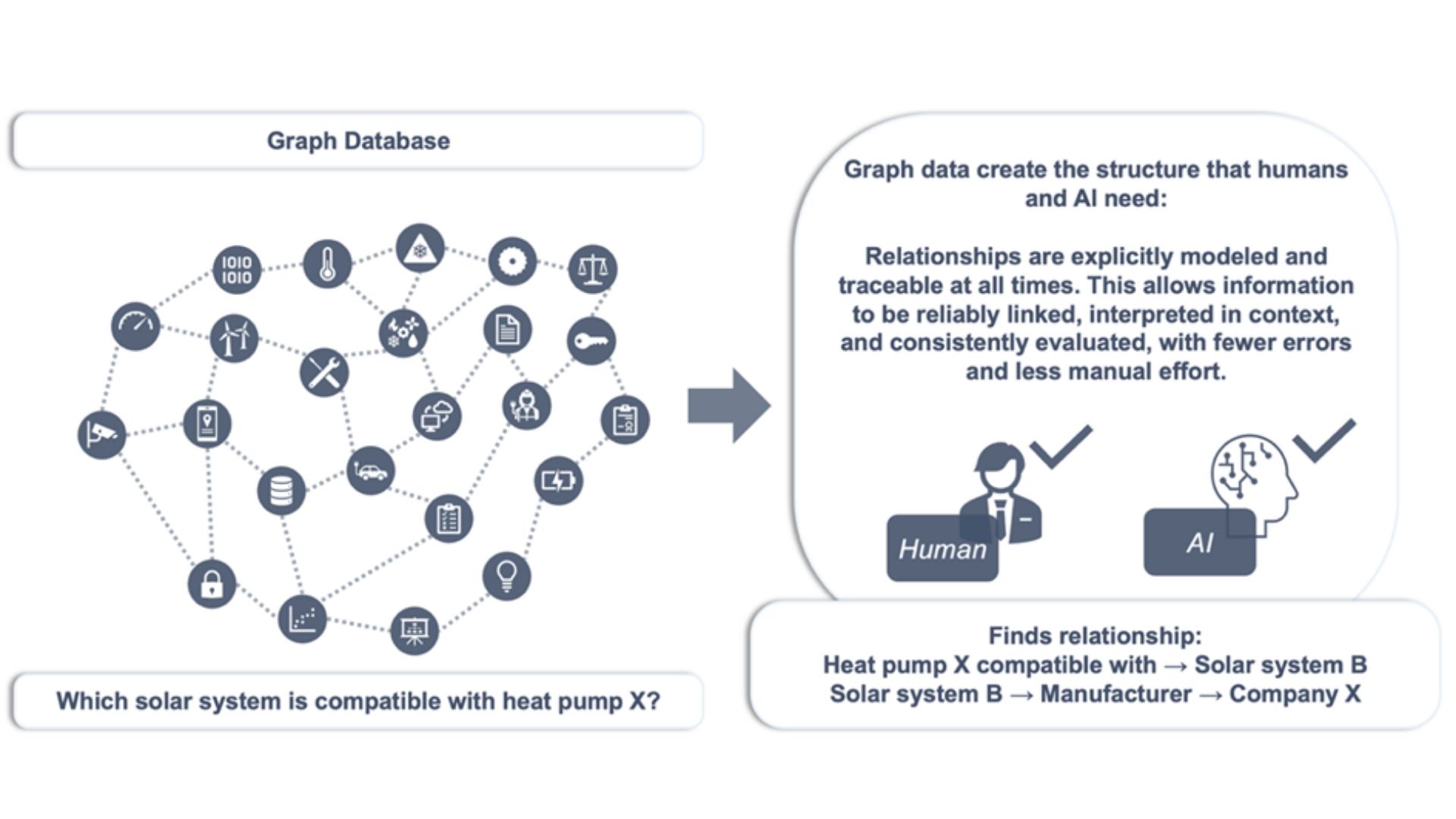
In the course of research, it quickly became clear that, in view of the complexity and the large number of domains involved, artificial intelligence can only be used in a scalable and comprehensible way if a structured data model is available. Without semantic structuring, AI applications lack the quality-assured database for domain-specific analyses, forecasts or agent-based approaches. The operator data model creates this prerequisite and at the same time makes it possible to systematically take into account explainability, traceability and security. Graph databases provide the necessary structure for this (Fig. 3): Relationships between assets, systems and domains are explicitly modeled and can be traced at any time, for humans as well as for AI applications.
Fig. 3: Graph databases create the structure that humans and AI need. Relationships are explicitly modeled and enable context-based, error-reduced evaluation (Image rights: Smart Building Real-World Lab Mainz University of Applied Sciences)
Fig. 3: Graph databases create the structure that humans and AI need. Relationships are explicitly modeled and enable context-based, error-reduced evaluation (Image rights: Smart Building Real-World Lab Mainz University of Applied Sciences)
These approaches are being tested and validated at the Smart Building Real-World Lab at Mainz University of Applied Sciences. Real university buildings serve as a living research environment, under real operating conditions, with real users and real data. The project and a first prototype of the operator data model based on linked data were presented at the BTGA e.V. booth at Light + Building 2026 in Frankfurt and presented in various specialist presentations.
Head of the Smart Building Real-World Lab at Mainz University of Applied Sciences
Fabian Naethbohm is head of the Smart Building Real-World Lab at Mainz University of Applied Sciences and specializes in IoT technologies, smart buildings, BIM in operations and data models. His work combines scientific principles with practical digitization concepts for buildings. It provides content on interoperable, semantic data models and contributes its research results from the real-world laboratory to the working group work of gefma and other associations.
Frank Schröder
Director of Efficient Technologies in Corporate Facility Management at Phoenix Contact
Frank Schröder is Director of Efficient Technologies in Corporate Facility Management at Phoenix Contact and has decades of experience in networked, industry-related building operations. His expertise includes energy-efficient building strategies, operating concepts, digitalization, IT/OT security and the practical operator perspective. In the gefma Building Operation 4.0 working group, Frank Schröder acts as a central bridge between industry and practice and contributes experience from over 300 buildings worldwide.