
Reading time: 5 minutes
Key takeaways
- In 2025, 299,000 heating heat pumps were sold in Germany. With a market share of 48 per cent, they were the country’s best-selling heating system.
- The next stage in heat pump development is not just about improving efficiency, but also about determining when electricity is drawn from the grid and heat is generated.
- AI-based control can link forecasts of future heat demand with dynamic electricity prices, allowing operation to be shifted to lower-cost periods.
- In the application studied, average electricity procurement costs were reduced by 7 to 11 per cent, with savings of up to 16 per cent in individual scenarios.
- When time-varying CO₂ factors were taken into account, operational CO₂ emissions fell by up to 13 per cent in the scenarios examined.
- Available storage capacity is a decisive factor in determining how flexibly heat generation can be decoupled from heat demand over time.
Heating buildings is one of the key areas that must be addressed on the path towards a climate-neutral building stock. Around 30 per cent of Germany’s CO₂ emissions are attributable to the provision of heat in buildings.1 One major reason is the continued widespread use of fossil fuels such as natural gas and heating oil for space heating and hot water. Reducing the associated emissions on a lasting basis will require a fundamental transformation of the way buildings are supplied with heat.
Heat pumps have a central role to play in decarbonising this supply. Because they rely primarily on electricity to provide heat, their operation can increasingly be powered by renewable electricity as renewable generation continues to expand. Their growing importance is also reflected in market figures: 299,000 heating heat pumps were sold in Germany in 2025. With a market share of 48 per cent, they were the country’s best-selling heating system.2
As heat generation becomes increasingly electrified, attention is shifting beyond the efficiency of the equipment itself towards smarter ways of operating it. The key question is no longer simply how efficiently a heat pump works, but also when it draws the electricity it needs. Fluctuating electricity prices and the growing share of renewable energy in the grid create opportunities to operate heat pumps more flexibly over time. By analysing existing operational and weather data, future developments can be anticipated and heat generation aligned more closely with expected demand. Artificial intelligence can help identify patterns in these data and generate the forecasts required for predictive operation.
From reactive to predictive heat pump operation
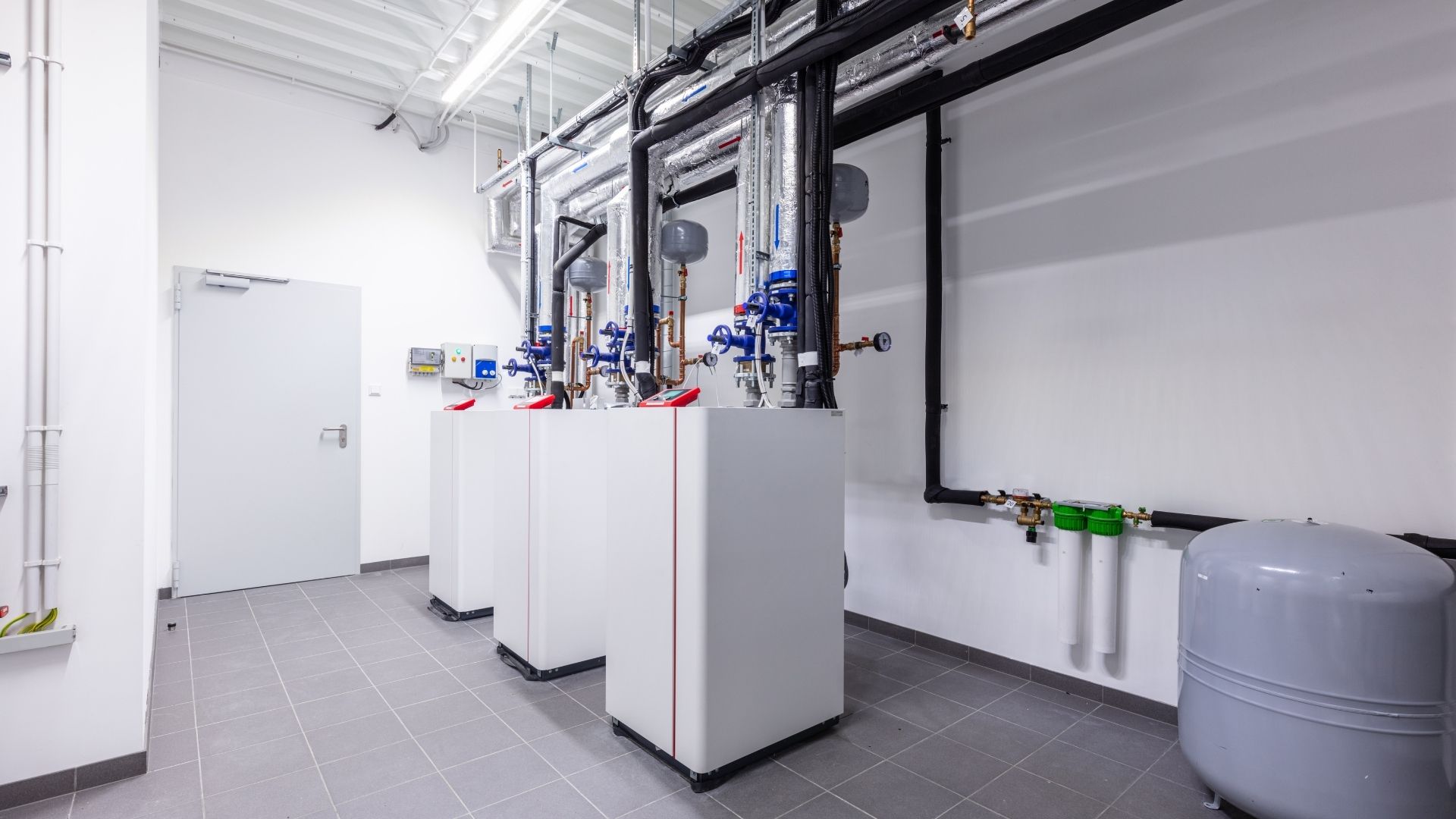
Jakob Ruser, a building services engineer at SOCOTEC Building Solutions, explored how this potential can be applied to a heat pump system in his master’s thesis, “Development of a model-predictive, AI-supported heat pump control system based on dynamic electricity tariffs for load management in a furniture store”. The aim was to develop a predictive control strategy capable of optimising the timing of heat generation by taking future heat demand and variable electricity prices into account. The case study focused on a furniture store in Bavaria whose heating system comprises three large-scale heat pumps with a combined thermal output of around 1.6 MW.
Unlike conventional heating controls, which primarily react to a building’s current state and activate heat generation when demand arises, the system developed in the study also takes future conditions into account. This makes it possible to determine in advance when heat should be generated, stored temporarily or supplied from storage.
Variable or dynamic electricity prices are a key factor in this approach. Prices fluctuate throughout the day, depending in part on electricity supply and demand. High levels of wind and solar generation in particular can lead to lower wholesale electricity prices, while high demand combined with lower supply tends to drive prices up. If the control system knows how prices are expected to develop, it can deliberately shift heat generation to more economical periods. For building operators, this creates an opportunity to optimise when heat pumps draw electricity and thereby reduce operating costs.
Data analysis provides the basis for looking ahead
To shift heat generation to more economical periods without compromising the building’s heat supply, the control system needs an accurate picture of how demand is likely to develop over the coming hours. Unlike electricity prices or weather forecasts, however, future heat demand is not directly available and must first be predicted. The study used real operational data from the furniture store collected over several heating seasons. Combined with weather data and other relevant variables, these data were used to train an AI model to forecast the building’s expected heat demand.
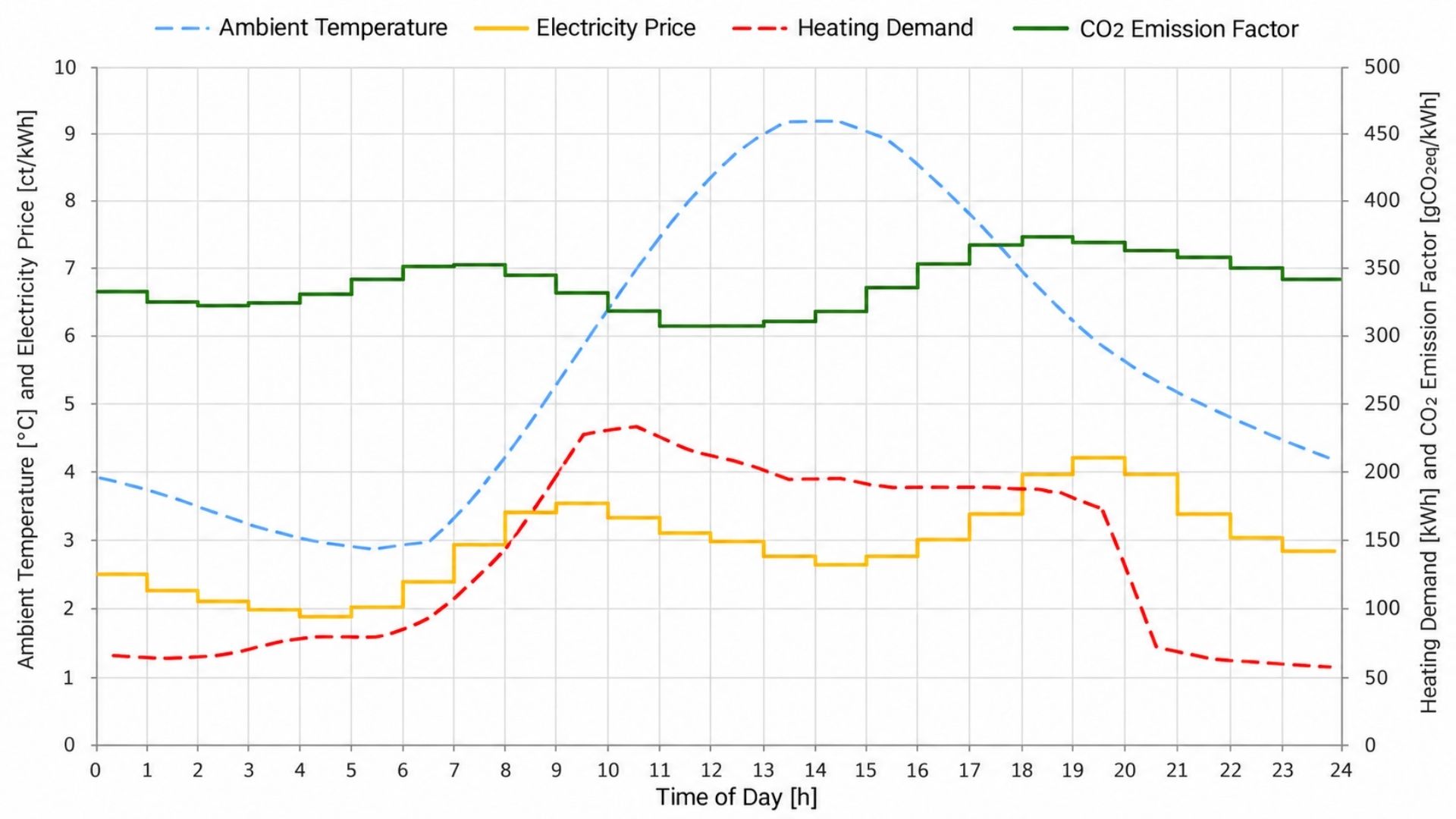
The average daily profile of heat demand, outdoor temperature, dynamic electricity prices and the CO₂ emissions factor for the 2019/20 heating season illustrates how the main input variables interact to form the basis of the control strategy. © SOCOTEC Building Solutions GmbH
“Building technology already generates large volumes of operational data, much of which is still not used systematically. The crucial step is not simply to collect this data, but to identify the relationships within it and put them to practical use in controlling heating systems. Artificial intelligence makes it possible to analyse existing data systematically and derive insights that can be used to optimise system operation,” explains Jakob Ruser.
The quality of the forecast is crucial. The more accurately future heat demand can be predicted, the more reliably the control system can plan heat pump operation in advance and take advantage of economically favourable operating periods. The study therefore also examined the additional benefit of an AI-based forecast compared with a simplified heat-demand prediction. The results showed that greater forecasting accuracy can further increase the economic optimisation potential of the control system.
Storage makes the difference
Sufficient thermal storage capacity is essential if heat generation is to be shifted over time. Storage allows heat to be generated when conditions are economically favourable and supplied to the building later. This decouples the timing of heat generation from actual heat demand. The greater the available storage capacity, the more flexibly the control system can respond to different electricity price periods and avoid operating at particularly expensive times.
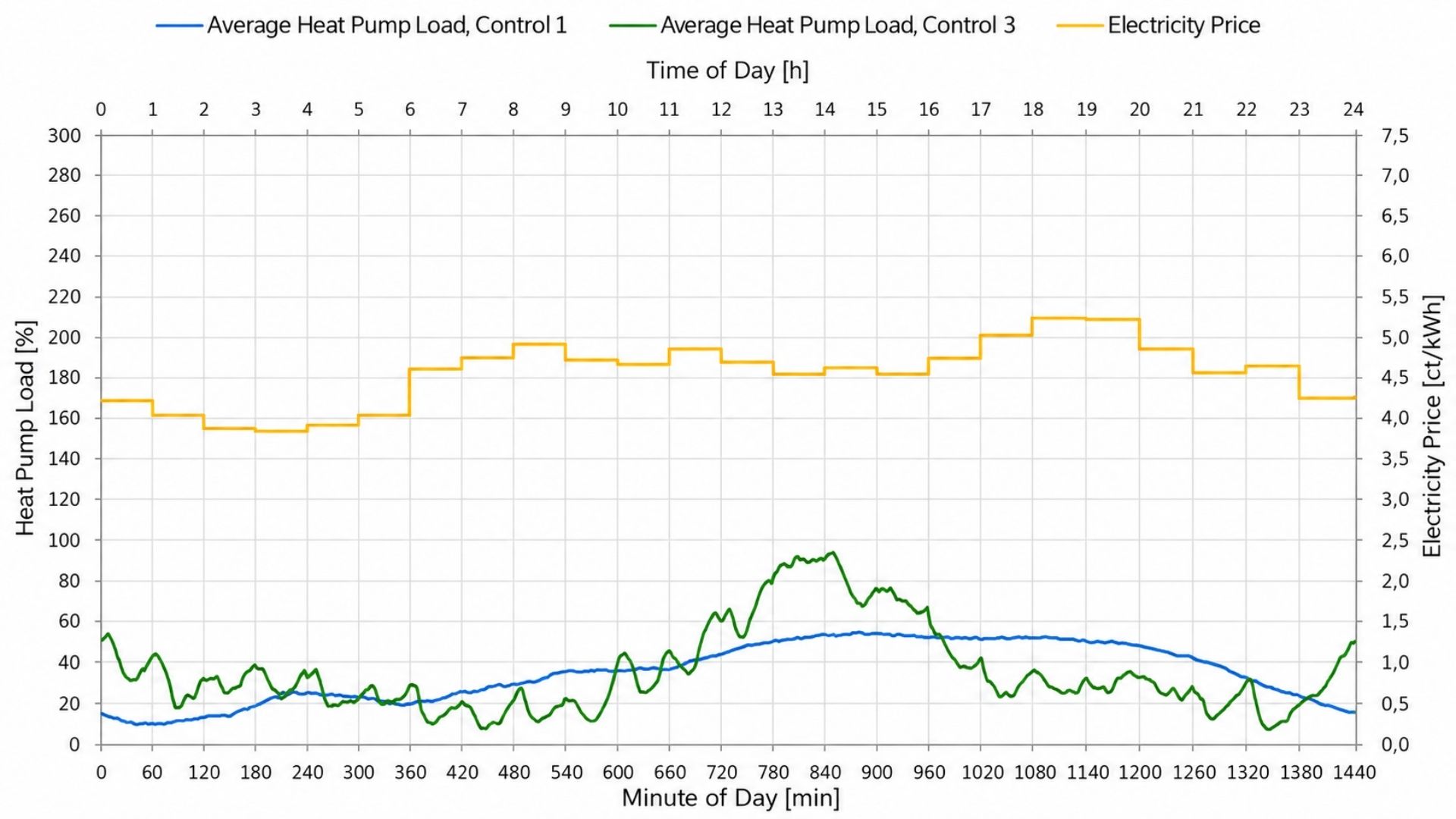
The average daily profile of the combined utilisation of the three heat pumps, comparing conventional control (1) with optimised control (3) at the largest storage size during the 2018/19 heating season, illustrates the effect of the optimisation. Compared with standard control, utilisation fluctuates more strongly and peaks during off-peak periods, particularly around midday, when the share of renewable energy in the grid is highest. © SOCOTEC Building Solutions GmbH
The simulation results primarily demonstrate the economic potential of combining predictive control, heat-demand forecasting and thermal storage. Compared with conventional operation, electricity procurement costs could be reduced significantly depending on the available storage capacity. “On average, savings of around 7 to 11 per cent were achieved, rising to as much as 16 per cent in some of the scenarios examined. The results also showed that available storage capacity in particular has a major influence on how effectively fluctuations in electricity prices can be used to optimise system operation,” Ruser summarises.
The study also examined the environmental potential of predictive operation. When time-varying CO₂ emissions factors were taken into account, operational CO₂ emissions were reduced by up to 13 per cent in the scenarios studied. The findings show that existing operational data can be used for more than analysing how systems performed in the past. Combined with AI-based forecasting and predictive control, they can contribute directly to optimising future operation. As more operational data becomes available and electricity supply from renewable sources becomes increasingly variable, approaches of this kind are likely to become even more important.
The principle is not limited to heat pumps. Wherever sufficient operational data is available in building technology and systems can respond flexibly to future requirements, there is potential for data-based forecasting and control. Artificial intelligence can help identify complex relationships within large datasets and provide the information needed to make building operation increasingly predictive and responsive to actual demand.