
Reading time: 4 minutes
Key Learnings
- The global smart building solutions market is expected to grow from $20.05 billion in 2025 to $41.07 billion by 2031 at a 12.7% CAGR.
- Europe is projected to grow from $5.77 billion to $11.50 billion over the same period.
- According to the market data used in the article, AI-enabled HVAC systems and building energy management platforms can reduce energy consumption by up to 30%.
- Predictive maintenance can reduce maintenance costs by 10% to 20% and cut unplanned downtime by up to 50%.
- Commercial buildings remain the leading end-user segment, with the market expected to nearly double by 2031.
- Agentic AI, unified building intelligence platforms, and cloud-based solutions for small and medium-sized commercial buildings are emerging as key growth areas.
What if a building could detect an HVAC fault, optimize energy consumption, maintain occupant comfort, and automatically trigger a maintenance request before a facility manager opened a dashboard?
That future is arriving faster than many realize.
Smart buildings are evolving beyond connected sensors and monitoring tools. Artificial intelligence is transforming buildings into intelligent environments that can analyze data, predict outcomes, and increasingly act autonomously. As organizations pursue sustainability goals, operational efficiency, and enhanced occupant experiences, smart building technologies are becoming strategic business investments rather than optional upgrades.
A Global Market Reaches an Inflection Point
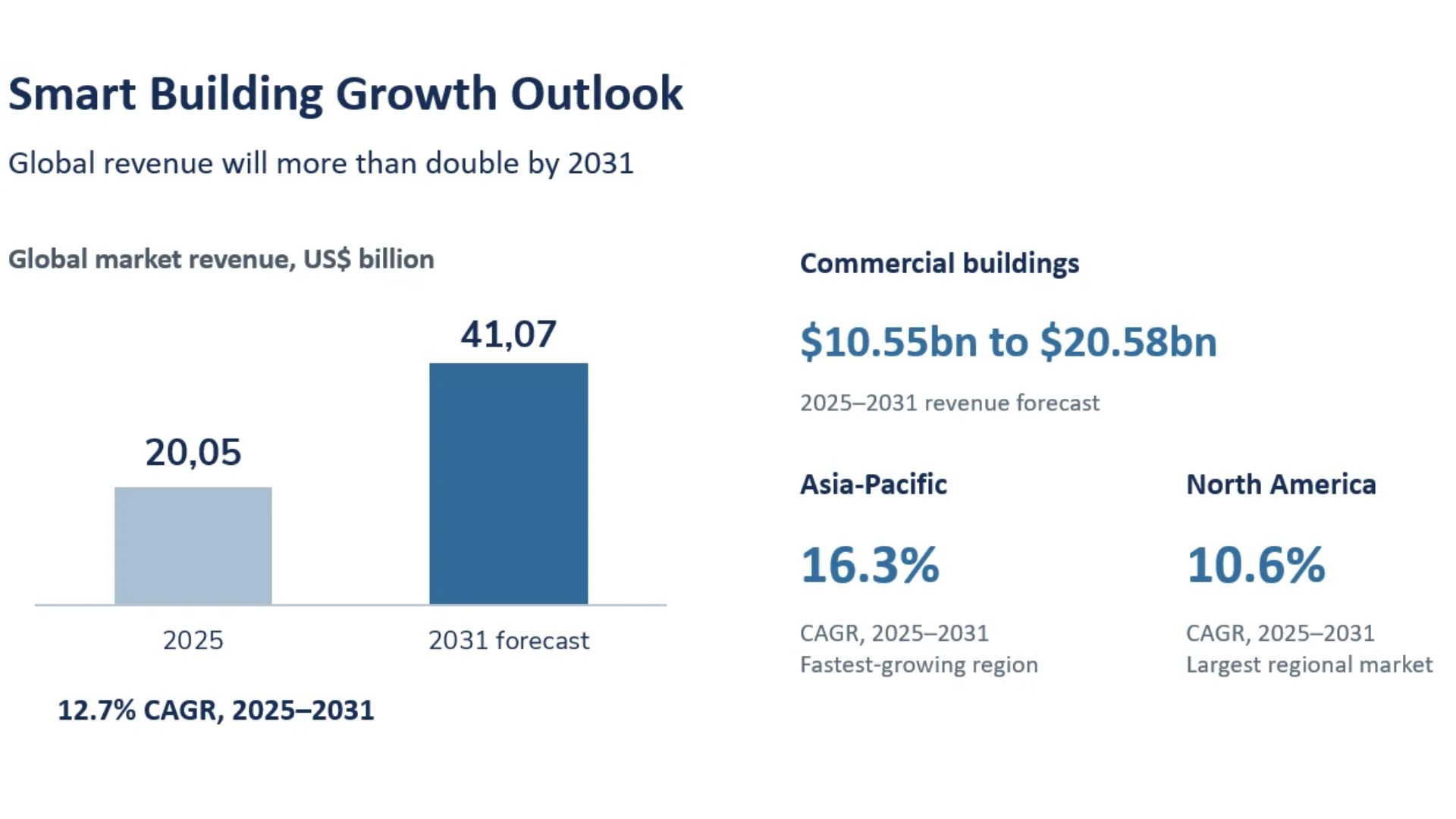
The global smart building solutions market is entering a period of accelerated growth. Frost & Sullivan estimates the market will expand from $20.05 billion in 2025 to $41.07 billion by 2031, representing a compound annual growth rate (CAGR) of 12.7%.
North America remains the largest market due to its mature building infrastructure and strong adoption of digital technologies. However, Asia-Pacific is expected to be the fastest-growing region as urbanization, sustainability initiatives, and government investments drive demand. Europe is also building momentum, with its market projected to grow from $5.77 billion in 2025 to $11.50 billion by 2031 at a 12.2% CAGR, supported by sustainability mandates, energy-efficiency regulations, and building modernization initiatives that continue to drive investment in smart building technologies.
The value proposition extends far beyond energy savings. AI-enabled HVAC systems and building energy management platforms can reduce energy consumption by up to 30%. Predictive maintenance can help reduce maintenance costs by 10% to 20% and cut unplanned downtime by as much as 50%. At the same time, cybersecurity and data privacy capabilities are becoming increasingly important as buildings connect more systems and devices.
Commercial Buildings Become the Primary Growth Engine
Commercial buildings remain the largest and most significant end-user segment for smart building solutions. Revenue from offices, retail properties, hotels, and mixed-use developments is expected to nearly double from $10.55 billion in 2025 to $20.58 billion by 2031.
A significant opportunity lies within small and medium-sized commercial buildings, many of which still have limited automation capabilities. Cloud-based building management systems are lowering deployment costs and reducing operational complexity, making smart building technologies accessible to a much larger addressable market.
For technology providers, success will depend on offering simple deployment, measurable outcomes, and scalable solutions. Building owners increasingly want investments that deliver clear returns through energy savings, operational efficiencies, risk reduction, and improved occupant experiences. This is especially relevant in Europe, where economic uncertainty, hybrid work patterns, office vacancy concerns, and the complexity of retrofitting older buildings are increasing demand for solutions that combine compliance support, interoperability, and clear business value.
Three High-Growth Opportunities Emerging in Smart Buildings
Three emerging opportunities are poised to shape the next phase of growth in the smart buildings market.
Agentic AI is pushing buildings beyond predictive analytics toward autonomous decision-making. Emerging applications include automated energy optimization, technician support, predictive service management, and conversational interfaces that allow operators to interact naturally with building systems. As these capabilities mature, facilities can improve operational efficiency, reduce maintenance costs, and respond to changing conditions in real time.
Another area gaining momentum is the rise of unified building intelligence platforms. By integrating building automation, energy systems, workplace technologies, real estate data, finance platforms, and enterprise applications, these solutions create a single source of truth across the organization. They can streamline ESG reporting, improve occupancy analytics, and support portfolio-wide decision-making. More importantly, these platforms create the digital foundation required for enterprise-wide optimization, autonomous operations, and future AI-driven services.
A further growth opportunity lies in cloud-based building management and energy management solutions for small and medium-sized buildings. Historically constrained by high implementation costs and operational complexity, this segment is becoming increasingly accessible through cloud-native and subscription-based offerings. Vendors that simplify deployment while delivering measurable outcomes will be well positioned to capture this largely untapped opportunity, which could exceed $1.00 billion over the next five years.
The Future Belongs to Autonomous Buildings
The next phase of market evolution will be defined by autonomy, integration, and broader accessibility. Leading smart building platforms are moving beyond monitoring and analytics toward systems capable of automatically identifying and resolving operational issues, unifying data across enterprise functions, and extending advanced capabilities to smaller buildings.
For building owners, occupiers, and technology providers alike, the opportunity is becoming increasingly compelling. Organizations that successfully combine AI, cloud architectures, cybersecurity, open integration, and ecosystem partnerships into outcome-driven solutions will be best positioned to capture future growth. The smart building is no longer defined by connectivity alone. It is evolving into an intelligent, adaptive, and increasingly autonomous asset capable of delivering measurable operational, financial, and sustainability outcomes.