
Reading time: 5 minutes
Key Learnings
- The heat pump revenue pools quantified in the source report rise from $56.37 billion in 2026 to $122.87 billion in 2035.
- Decarbonization, carbon pricing, incentives, and energy security are key structural market drivers.
- Technology advances are expanding the addressable market through higher supply temperatures and new process-heat applications.
- Low-GWP refrigerants, digital monitoring, and predictive maintenance are becoming increasingly important.
- Competition is shifting from equipment sales toward system integration, software, financing, and lifecycle services.
- Heat-as-a-Service can lower upfront investment barriers but increases requirements for financing, operations, and performance verification.
- Skills shortages, high initial costs, energy-price dynamics, and supply-chain constraints remain major barriers to growth.
Heat pumps move from alternative to strategic infrastructure
Heat pumps are entering a new phase of market development. Once viewed mainly as efficient replacements for conventional heating equipment, they are becoming strategic assets in the electrification of heat, the reduction of fuel dependence, and the management of energy demand. Frost & Sullivan’s outlook points to strong expansion through 2035, supported by policy, technology improvement, and new commercial models. Across the revenue pools quantified in the source deck, annual revenue rises from a combined $56.37 billion in 2026 to $122.87 billion in 2035. The direction is clear: heat pumps are moving toward the center of energy and decarbonization strategies.
This expansion will not be uniform. Adoption will depend on local electricity and gas prices, building stock, climate, grid conditions, and policy continuity. Even so, the long-term trajectory is reinforced by several structural forces that are unlikely to reverse.
Policy is turning demand into a structural market
Decarbonization targets remain the strongest market catalyst. Governments are increasingly treating the electrification of heat as a policy objective rather than an optional consumer decision. In Europe, initiatives including REPowerEU, the revised Renewable Energy Directive, and the Energy Efficiency Directive support the replacement of fossil-based heating and the renovation of existing assets. Carbon pricing, including the planned extension of emissions trading, can further improve lifecycle economics by increasing the cost of fossil heat.
Incentives still matter because upfront investment remains a major barrier. Grants, rebates, tax credits, and renovation funding can close the affordability gap and support market development. However, policy stability is as important as the level of support. Sudden changes to subsidies can create demand spikes followed by sharp contractions, disrupting manufacturers, installers, and investors. The most effective frameworks combine multi-year visibility, tighter efficiency requirements, and a gradual increase in the cost of carbon-intensive heating.
Energy security adds another layer of support. Fuel price volatility and concern over imported energy are strengthening the case for electrified heating. This positions heat pumps not only as emissions-reduction technologies, but also as tools for resilience and long-term supply security.
Technology is widening the addressable opportunity
The technology case is improving rapidly. Advances in compressors, heat exchangers, thermodynamic cycles, and variable-speed operation are raising efficiency and extending performance in colder climates. Supply temperatures can now reach about 75°C in some building applications, improving compatibility with existing radiator systems and reducing retrofit complexity. For process heat, commercial solutions are increasingly viable below 160°C, while selected systems are approaching 200°C. These gains expand the range of sites where heat pumps can displace fossil-fuel systems.
Refrigerants are becoming a competitive battleground. Regulation is accelerating the shift toward low-global-warming-potential options, including propane, ammonia, carbon dioxide, and water. Propane, or R290, is gaining momentum because it combines very low warming potential with the ability to support higher water temperatures. This transition affects compressor architecture, heat exchanger design, safety systems, installation practices, and product certification. Suppliers with deep refrigerant expertise and compliant portfolios will be better placed as environmental rules tighten.
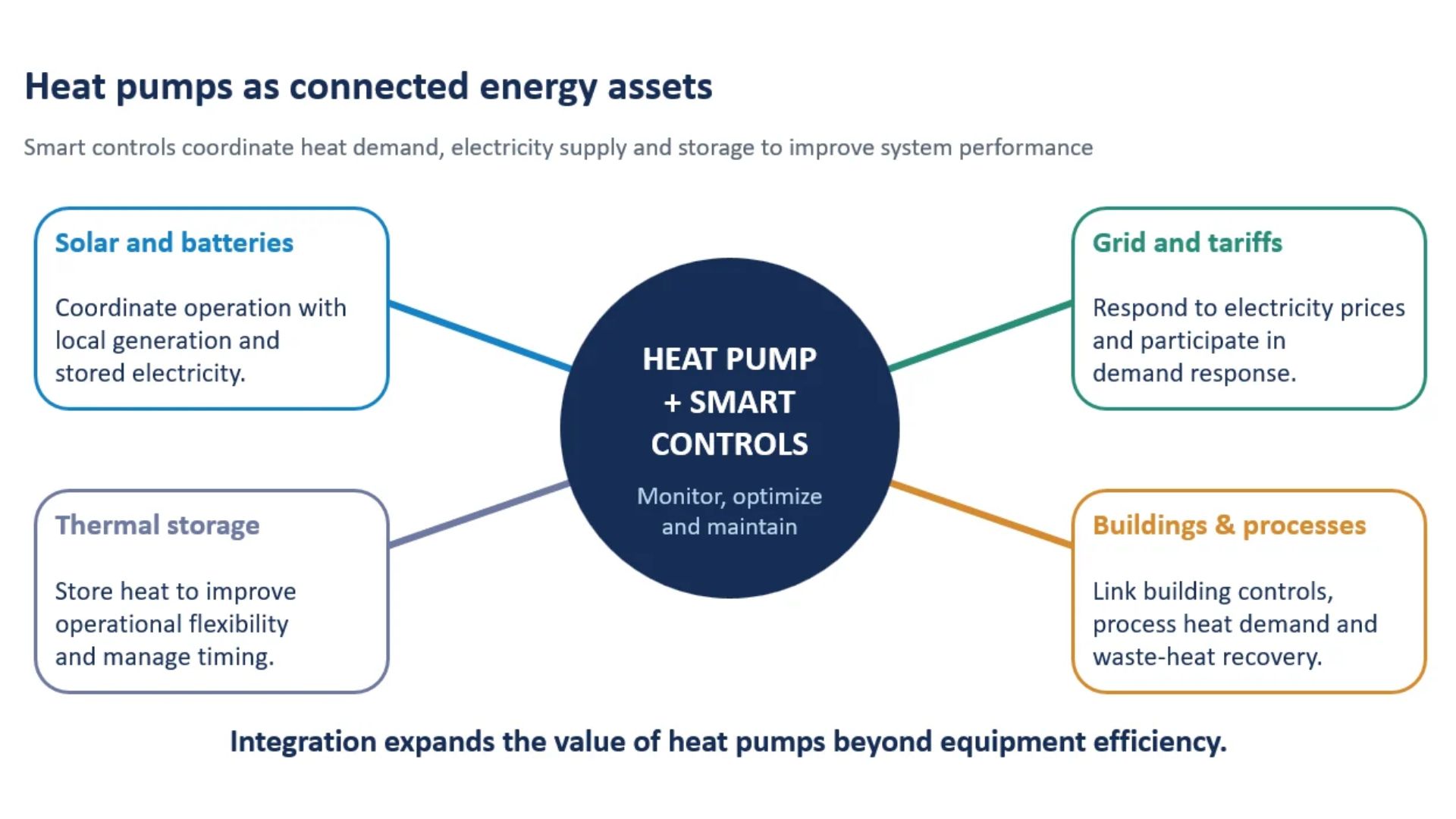
Digitalization is equally important. Connected controls, real-time monitoring, remote diagnostics, and predictive maintenance can improve efficiency and reduce downtime. When linked with electricity tariffs, thermal storage, solar generation, batteries, building management systems, and demand-response platforms, heat pumps become flexible energy assets rather than standalone appliances.
Source: Frost & Sullivan
Competition shifts from products to outcomes
Hardware performance will remain essential, but it will no longer be enough. Competitive advantage is expanding toward system integration, software, financing, and lifecycle service. Customers increasingly want predictable costs, verified savings, and lower execution risk. This is encouraging equipment suppliers, utilities, energy service companies, and financial institutions to collaborate across the project lifecycle.
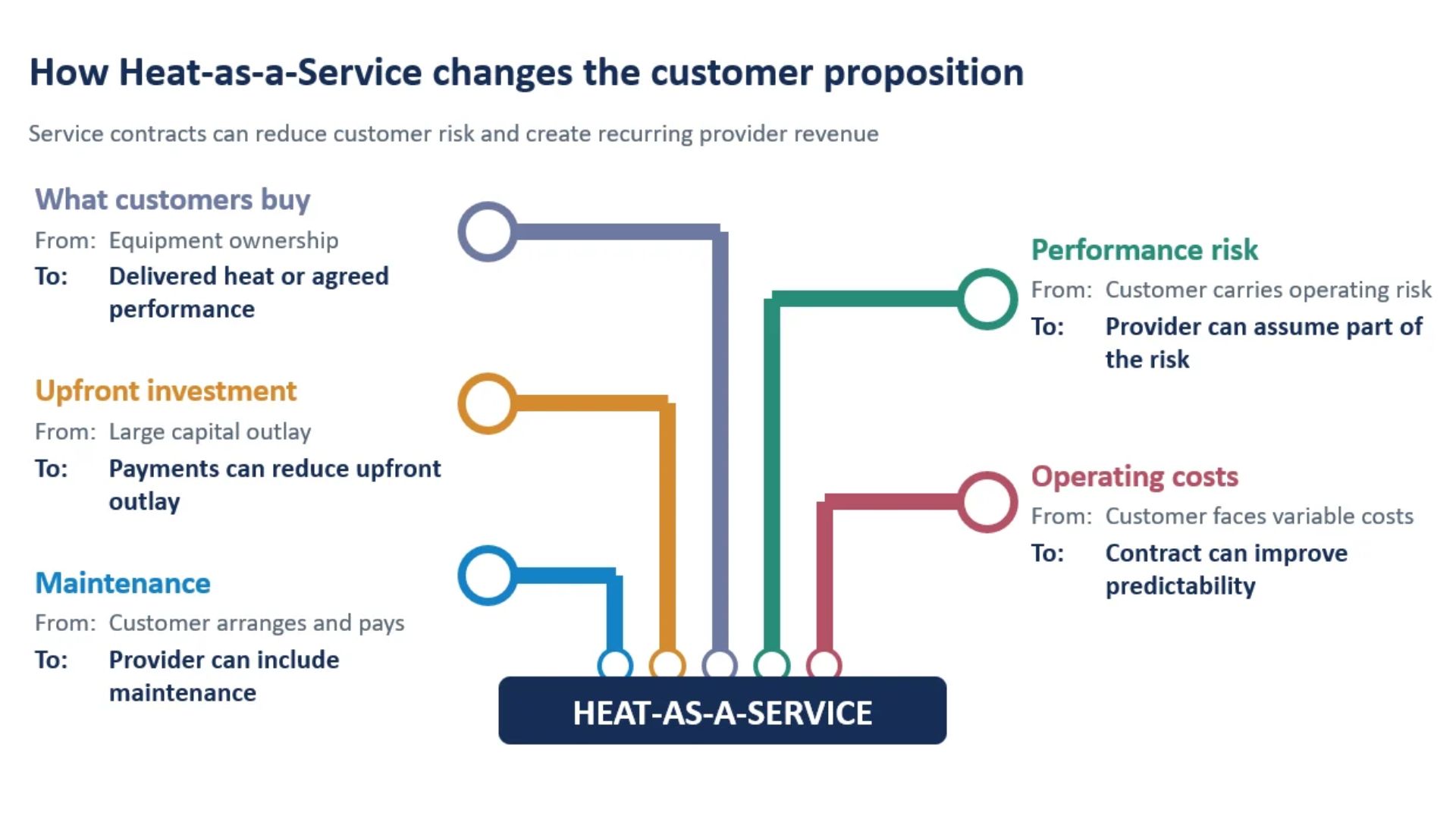
Heat-as-a-Service illustrates this shift. Instead of purchasing equipment outright, a customer can pay for delivered heat or agreed performance. The provider may finance the asset, maintain it, monitor efficiency, and assume part of the operational risk. This converts capital expenditure into an operating expense, reduces the burden of ownership, and can make adoption easier where upfront budgets are constrained. For providers, long-term contracts create recurring revenue, improve customer retention, and generate operating data that can be used to optimize performance.
Source: Frost & Sullivan
The model also raises the bar for execution. Providers must price energy and performance risk accurately, secure cost-effective financing, and maintain assets over long periods. Strong digital measurement and verification will therefore be central to bankable service offers.
Market barriers will shape the pace of growth
Despite the positive outlook, several constraints could slow deployment. High initial costs remain the most visible obstacle, particularly where electrical upgrades or complex retrofits are required. The relative price of electricity and natural gas can materially alter payback periods. Cheap gas can weaken the financial case, while volatile power prices create uncertainty for customers.
Skills are another bottleneck. Shortages of qualified designers, installers, engineers, and commissioning specialists can raise costs and limit deployment capacity. Supply-chain resilience, manufacturing scale, and lead times will also influence which companies can convert demand into revenue. Market growth will therefore depend not only on product innovation, but also on workforce development, standardized installation practices, and dependable after-sales support.
Strategic priorities through 2035
Three priorities stand out. First, suppliers should embed intelligent optimization, including AI-enabled controls, predictive analytics, and tariff-responsive operation. Second, they should connect heat pumps with solar, storage, electric vehicle charging, and energy-management platforms to create integrated low-carbon ecosystems. Third, they should develop outcome-based offers that combine equipment, controls, software, financing, monitoring, and service.
The market is moving toward solutions that deliver measurable energy, cost, and carbon outcomes. Companies that pair efficient hardware with digital intelligence, low-GWP refrigerants, scalable service capacity, and credible financing will be best positioned to capture growth. By 2035, leadership will be defined less by the sale of a heating unit and more by the ability to manage heat as a flexible, reliable, and decarbonized energy service.
Download
Download additional insights and market data on the global heat pump market to better understand market potential, technology developments, and the key growth drivers through 2035.
- Turning Up the Heat: The Heat Pump Opportunity to 2035 (pdf, 930 KB)