
Reading time: 4 minutes
Key Learnings
- Electrification is moving from a decarbonization approach to a growth strategy for buildings and industry.
- Heat pumps, electric boilers, waste heat recovery, electric backup systems, and smart controls are the most relevant technologies.
- Low- and medium-temperature applications offer the clearest near-term opportunity for electrification.
- Digitalization, storage, solar PV, and load management significantly improve the business case for electrified systems.
- Grid capacity, financing, workforce skills, controls, and existing infrastructure are the critical implementation factors.
- EDGE Amsterdam West shows how an existing building can be transformed through electrification, storage, and digital systems.
Electrification Becomes a Strategic Growth Platform
Electrification in the built environment is no longer a distant decarbonization ambition. For buildings and industrial facilities, it is becoming a practical growth pathway that links cleaner thermal systems, smarter energy management, and more resilient on-site power strategies. The shift is especially relevant for building owners, facilities teams, and technology providers seeking to reduce fossil fuel dependence across heating, hot water, process support loads, backup systems, and peak-demand applications.
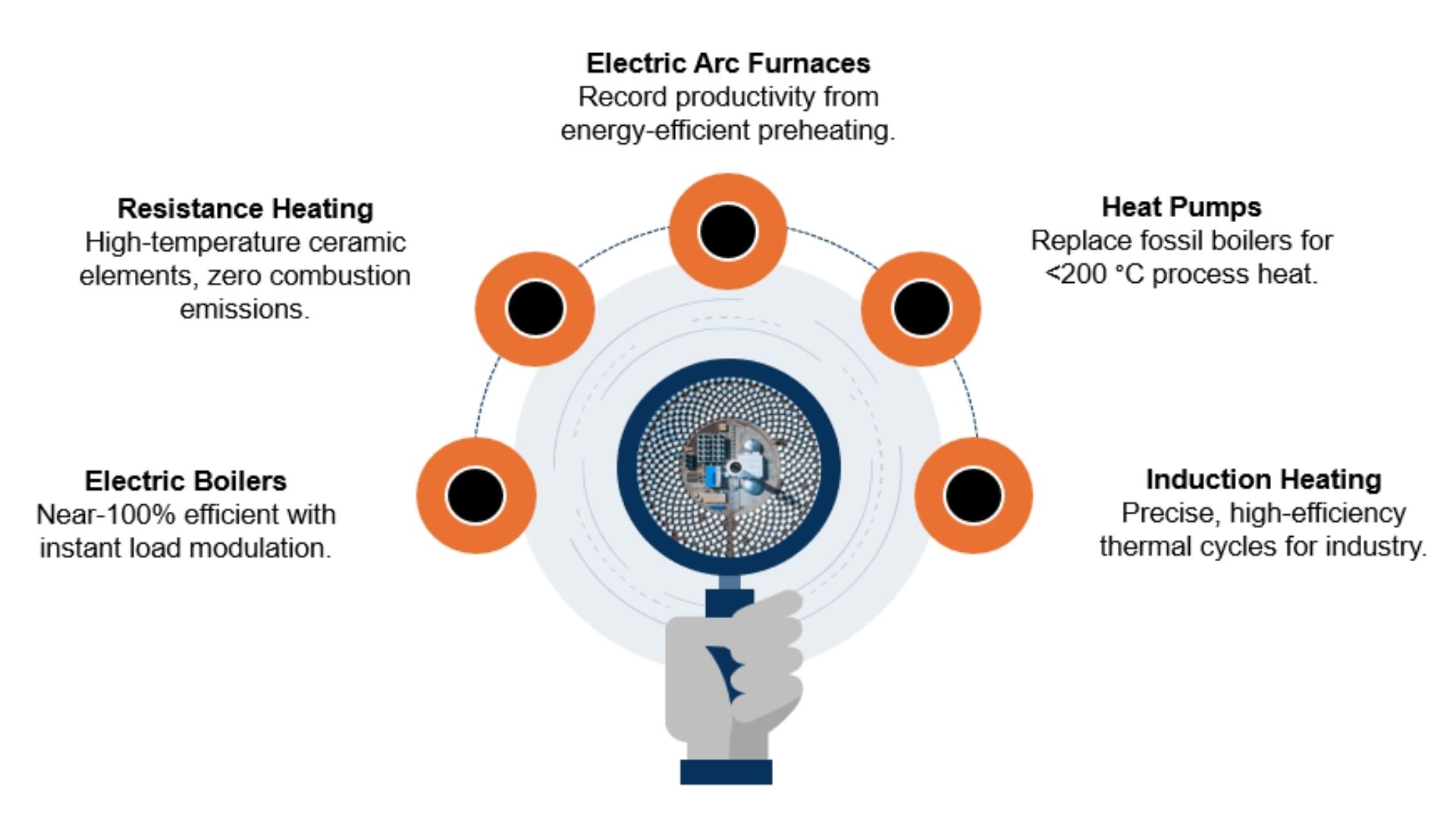
In industrial electrification, the opportunity spans five core technologies including resistance heating, electric boilers, electric arc furnaces, industrial heat pumps, and induction heating. In a building context, the most immediate relevance lies in heat pumps, electric boilers, waste heat recovery systems, electric backup and peak-load equipment, and controls that coordinate these assets with solar PV, battery storage, EV charging infrastructure, and building energy management systems. Together, these solutions are expanding electrification beyond production processes and into the wider building energy ecosystem.
The market outlook reflects this structural shift. Frost & Sullivan forecasts global revenue for industrial electrification technologies to rise from $13.76 billion in 2025 to $26.81 billion in 2035, representing a CAGR of 6.9%. This growth is driven by a broad industrial modernization cycle across steel, chemicals, oil and gas, food and beverage, paper and pulp, and glass and ceramics industries. As organizations seek greater energy efficiency, lower emissions, and improved operational resilience, electrification is becoming a critical element of long-term investment strategies.
Commercially Ready Technologies Shift the Focus to Execution
Technology readiness is no longer the primary obstacle. Electric boilers provide an efficient route to steam generation and can often be integrated into existing steam or hot water systems with minimal disruption. Heat pumps are increasingly capable of serving low and medium temperature loads in factories, campuses, hospitals, commercial buildings, and mixed-use facilities, especially where they can recover heat from chillers, data rooms, refrigeration systems, exhaust air, wastewater, or process streams. Electric resistance and induction technologies offer precise temperature control in demanding applications, while electric backup and peak-load systems can support resilience when paired with storage and intelligent load management. The challenge has shifted from technology availability to implementation considerations such as financing, grid readiness, workforce development, controls integration, and policy support.
Technology Readiness: Electrification No Longer a Bottleneck
Low and Medium Temperature Processes Create the Near-Term Opening
Among all opportunities, low and medium temperature applications are emerging as the most attractive starting point. Processes such as pasteurization, washing, drying, tank heating, evaporation, domestic hot water, space heating, and low-temperature distribution loops can already be electrified using commercially proven technologies. For building portfolios, this provides a practical pathway for applying electrification technologies to building decarbonization, as heat pumps and waste heat recovery can reduce boiler dependence, improve overall system efficiency, and support staged retrofits without requiring a full redesign of the facility. These projects often involve lower technical risk, moderate capital requirements, and clearer economic justification than more complex high temperature applications.
Digital and Energy Innovations Improve the Business Case
Digitalization is further strengthening the investment case. Artificial intelligence (AI), connected controls, and energy management platforms are helping operators optimize energy consumption, improve process stability, and coordinate electrified loads with building demand patterns. In buildings, this includes sequencing heat pumps and electric boilers, using waste heat when available, shifting non-critical loads away from peak tariff periods, managing EV charging demand, and aligning thermal production with solar PV output or battery discharge. Electrification is therefore increasingly being deployed as part of a managed energy ecosystem rather than as a standalone equipment replacement.
Market momentum is also being supported by falling renewable energy costs and the growing adoption of behind-the-meter energy solutions. Solar generation, battery storage, thermal storage, and EV charging infrastructure are improving the economics of electrified buildings and facilities by increasing self-consumption, reducing exposure to grid price volatility, and supporting backup or peak-load operation. At the same time, new financing models, leasing structures, and performance-linked commercial arrangements are helping customers overcome traditional capital expenditure barriers.
Infrastructure and Skills Will Determine Adoption Speed
Despite these positive developments, several challenges remain. Grid congestion, lengthy interconnection timelines, workforce skill gaps, and uncertainty around electricity costs continue to slow adoption in some markets. Many existing facilities such as large industrial sites and commercial buildings require upgrades to electrical infrastructure before large-scale electrification can proceed, particularly when heat pumps, electric boilers, EV chargers, batteries, and backup systems are added to the same site. Success will therefore depend not only on technology deployment, but also on careful load planning, controls integration, workforce development, and long-term energy strategies.
Case Study: EDGE Amsterdam West Retrofitted Commercial Office Building
EDGE Amsterdam West is a retrofitted commercial office building in Amsterdam, Netherlands, and shows how an existing 1970s asset can be transformed into an energy-positive building. The office was refurbished with more than 6,000 m² of solar panels, underground thermal energy storage, upgraded façades and insulation, automated ventilation, night cooling, and smart sensors for lighting, climate, and occupancy control. The project upgraded the building from EPC F to A++++ and reported net operational energy use of 0 kWh/m²/year, demonstrating how electrification, renewables, thermal storage, and digital controls can work together in a commercial retrofit.
Outlook: From Emissions Reduction to Competitive Advantage
Looking ahead, industrial electrification is expected to become a cornerstone of modernization across both production environments and building systems. Growth will be driven not only by emissions reduction targets, but also by the pursuit of greater productivity, energy security, operational flexibility, and competitive advantage. Organizations that integrate electrified heat with waste heat recovery, solar PV, battery storage, charging infrastructure, and intelligent energy management will be best positioned to reduce operating risk while creating more flexible, lower-carbon facilities.