

Reading time: 6 minutes
Key Learnings
- The global HVAC market is expected to grow from USD 255.40 billion in 2025 to USD 383.60 billion in 2031. Eingefügter Text
- Regional demand differs sharply: cooling dominates in Asia-Pacific and the Middle East, while heating leads in North America and Europe. Eingefügter Text
- Regulation is becoming the main demand driver because new efficiency and electrification rules accelerate replacement cycles. Eingefügter Text
- Three growth areas stand out: connected services, intelligent controls, and specialized cooling solutions for data centers. Eingefügter Text
- In Europe, the biggest opportunities lie in retrofit, compliance, and integrated modernization of the building stock. Eingefügter Text
- Key barriers remain high upfront capex, long development cycles, and especially the shortage of skilled labor.
For most of its history, the HVAC industry sold boxes. Chillers, air handlers, split systems, and boilers were engineered products moved through distributors and contractors, judged on cost, reliability, and how fast they could be delivered. That business is still there. But the numbers now tell a different story about where the value is going.
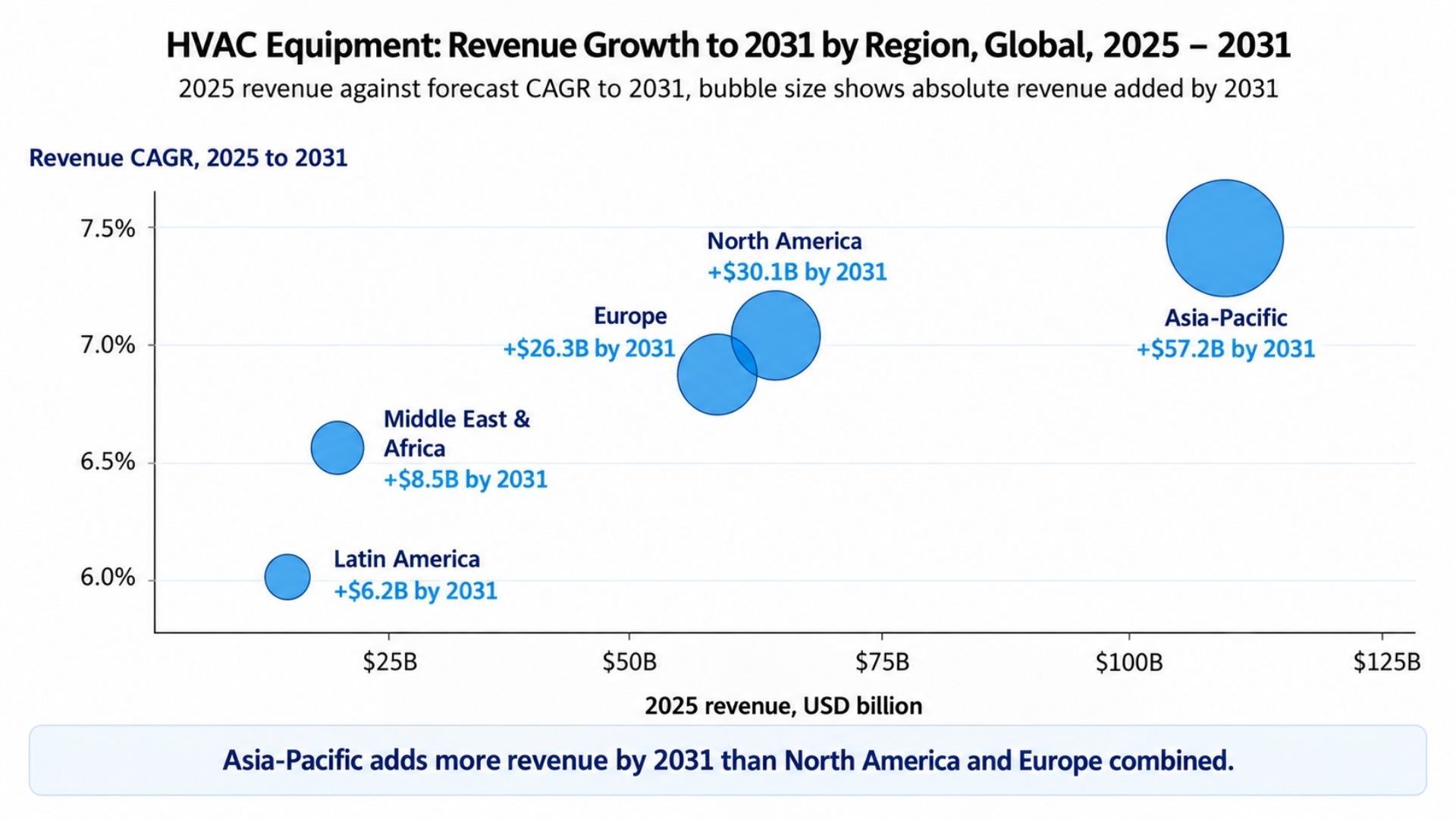
Global HVAC equipment revenue is set to climb from $255.40 billion in 2025 to $383.60 billion by 2031, a 7.0% CAGR. That is roughly $128 billion of new annual revenue created inside six years. What makes the trajectory interesting is not the headline growth. It is the fact that three very different forces are producing it at the same time, namely a warming planet, a wave of efficiency regulation, and the arrival of software in a category that has historically resisted it.
Cooling carries the market, but the mix is regional
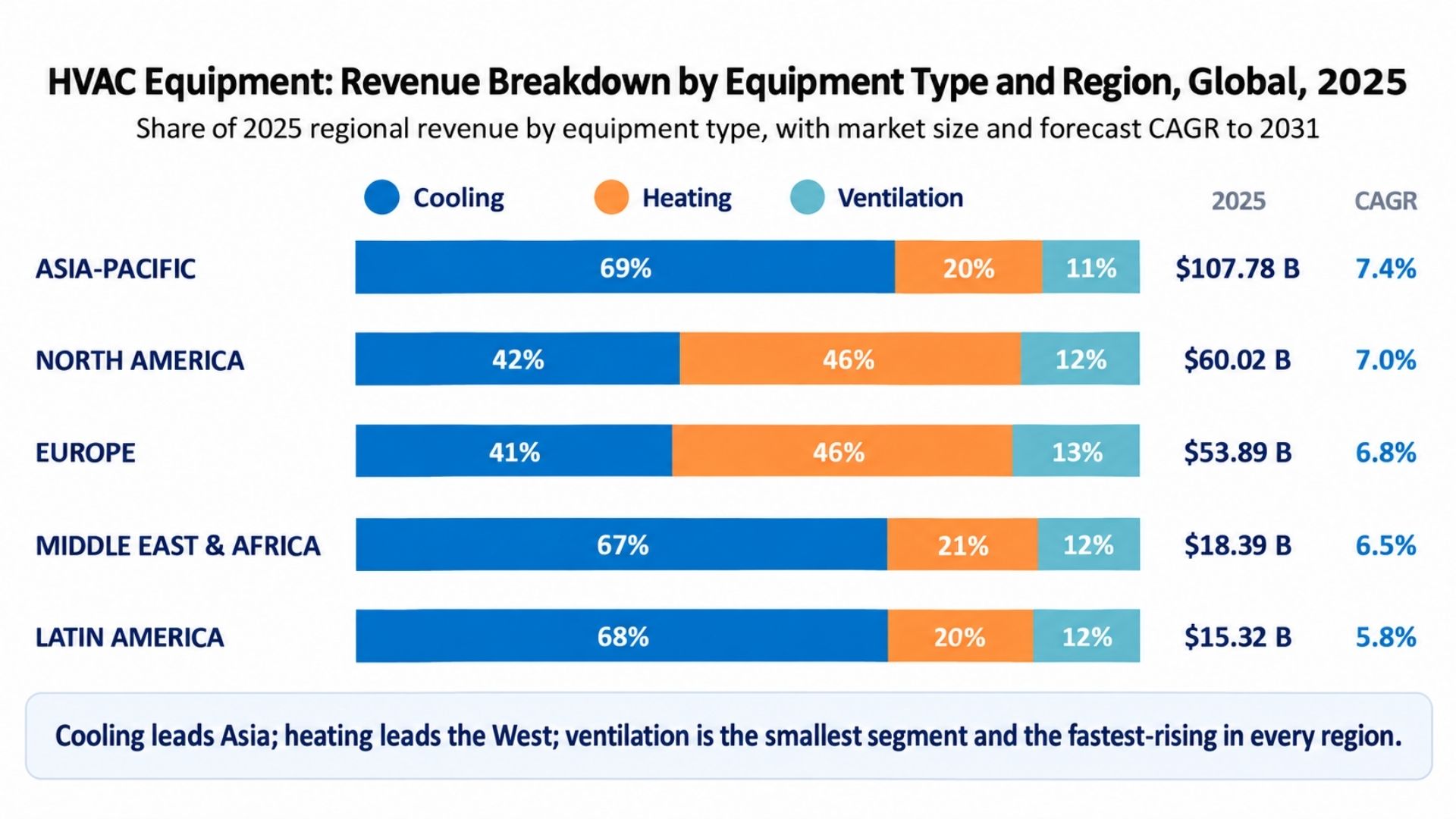
Globally, cooling accounts for 56.4% of 2025 revenue, heating 31.8%, and ventilation 11.8%. Yet that global average conceals almost everything that matters commercially, because the equipment mix flips completely depending on where you look.
In Asia-Pacific, the largest regional market at $107.78 billion and growing 7.4% to $164.95 billion, cooling is 69.1% of revenue. Heatwaves across China, India, and Thailand are pulling demand forward, while air quality concerns lift ventilation to a 7.7% CAGR. In the Middle East and Africa, cooling is 66.6%, anchored by summers regularly above 45°C in Saudi Arabia, the UAE, and Kuwait, where district cooling is becoming the default solution for large developments. Latin America looks similar at 67.8% cooling, but with an unusual vertical profile of 56.2% residential, the most homeowner-weighted market in the region set.
Now invert it. In North America, heating is the largest segment at 46.4%, ahead of cooling at 41.5%. Europe is nearly identical at 46.2% heating. These are not warmer-climate markets discovering air conditioning. They are electrification markets, where heat pumps are displacing fossil-fuel heating.
The strategic implication is uncomfortable for anyone running a single global playbook. A product roadmap optimised for Asia-Pacific cooling volume is close to the inverse of what wins in Germany.
Regulation is now the primary demand-creation mechanism
The most reliable growth in this market is not being created by customers deciding they want new equipment. It is being created by rules that make the old equipment non-compliant.
Germany's Building Energy Act requires new heating systems to draw at least 65% of their energy from renewables from 2025, which is doing more for electric heat pump demand than any marketing campaign could. The EU Green Deal and the revised EPBD are steering buildings away from fossil fuel heating region-wide. In North America, electrification plus tax credits and rebates are shifting demand toward heat pumps across diverse climates. In the Gulf, green building codes, the low-GWP refrigerant transition, and Dubai's retrofit programme covering roughly 30,000 buildings are lifting replacement-cycle value. Even Latin America, the slowest-growing region at 5.8%, is seeing stricter efficiency standards steer buyers toward higher-efficiency equipment in both new build and renovation.
This is why the retrofit channel deserves more attention than it usually gets. Regulation converts a discretionary upgrade into a deadline. It compresses replacement cycles and makes demand more forecastable than new construction ever was, which matters when buildings consume roughly 40% of global energy and remain a central net-zero target.
Ventilation is the quiet beneficiary. It is the smallest segment everywhere and the fastest-growing one, at 7.3% in North America and 7.1% in Europe where heat recovery and demand-controlled systems lead, driven by multi-stage filtration, HEPA, and UVGI moving from optional to specified. Indoor air quality moved from a wellness talking point to a code requirement, and the equipment market followed.
Three Growth Opportunities Reshaping HVAC
HVAC growth is shifting beyond equipment toward connected services, intelligent controls, and specialised cooling. Vendors should embed IoT sensors and cloud analytics to enable remote diagnostics, predictive maintenance, and recurring service revenue. AI and machine learning can support self-tuning systems that respond to occupancy, weather, and energy prices while optimising loads across zones. Data centre expansion creates a third opportunity: precision cooling, including direct-to-chip, immersion, in-row, and modular solutions, for high-density infrastructure with lower PUE and stronger sustainability performance.
Europe’s HVAC Opportunity Is a Retrofit and Compliance Play
Europe’s market will reward vendors that treat regulation as a route to recurring retrofit revenue, not merely a product-compliance exercise. With market revenue projected to rise from $53.89 billion in 2025 to $80.17 billion by 2031, the strongest position combines electrified heating, low-GWP refrigerants, heat-recovery ventilation, controls, and lifecycle services. The opportunity is especially attractive in aging buildings, where owners need coordinated upgrades to meet tighter performance standards. Winning vendors will simplify financing, installation, commissioning, and performance verification through local partnerships.
Commercial buildings offer a particularly attractive route to scale because offices, retail sites, hotels, hospitals, and public facilities face high operating costs and increasingly measurable performance obligations. Rather than replacing equipment in isolation, owners will favour integrated retrofits that combine heat pumps, heat-recovery ventilation, smart controls, and continuous energy monitoring. Vendors that can demonstrate verifiable savings, minimise disruption, and support multi-site portfolio upgrades will be best positioned to capture larger, repeatable contracts.
What stands in the way
The barriers are structural rather than cyclical. High upfront capex and an annual maintenance burden slow adoption. Heavy R&D spend with slow time to market delays revenue. Most acutely, an ageing installer workforce and limited technical talent constrain how fast anything sophisticated can actually be deployed, because you cannot scale AI-optimised systems faster than you can staff their commissioning. Low end-user awareness of IoT-enabled HVAC also keeps smart system uptake below its potential.
The bottom line
Three moves separate leaders from followers over the next six years. First, regionalise the portfolio rather than the marketing, with heat pumps and heating-led offers for North America and Europe, and cooling density and efficiency for Asia-Pacific, the Middle East and Africa, and Latin America. Second, build the retrofit and compliance business deliberately, because regulation is generating the most predictable demand in the market. Third, monetise connectivity, since recurring service revenue rather than equipment margin is what will hold up when the hardware becomes commoditised.
Download
Download additional insights and market data on the global HVAC market to better understand regional differences, regulatory drivers, and emerging growth areas.
- Global HVAC Equipment Growth Outlook (pdf, 863 KB)