
Reading time: 6 minutes
Key Learnings
- The global genset market continues to grow, but its structure is changing: diesel remains dominant while gas units are expanding faster.
- For buildings and critical infrastructure, gensets are increasingly becoming part of connected energy and building management systems.
- Sustainability, digitalization, decentralization, and new business models are driving the industry’s transformation.
- Demand is concentrating in data centers, commercial buildings, healthcare facilities, and other power-intensive applications.
- For manufacturers, hybridization, digital services, local partnerships
The global generator set (genset) industry is entering a decade defined less by capacity expansion than by transformation. For commercial buildings and critical infrastructure, this development matters because gensets are increasingly being integrated into connected energy and building-management systems rather than operating as stand-alone backup assets.
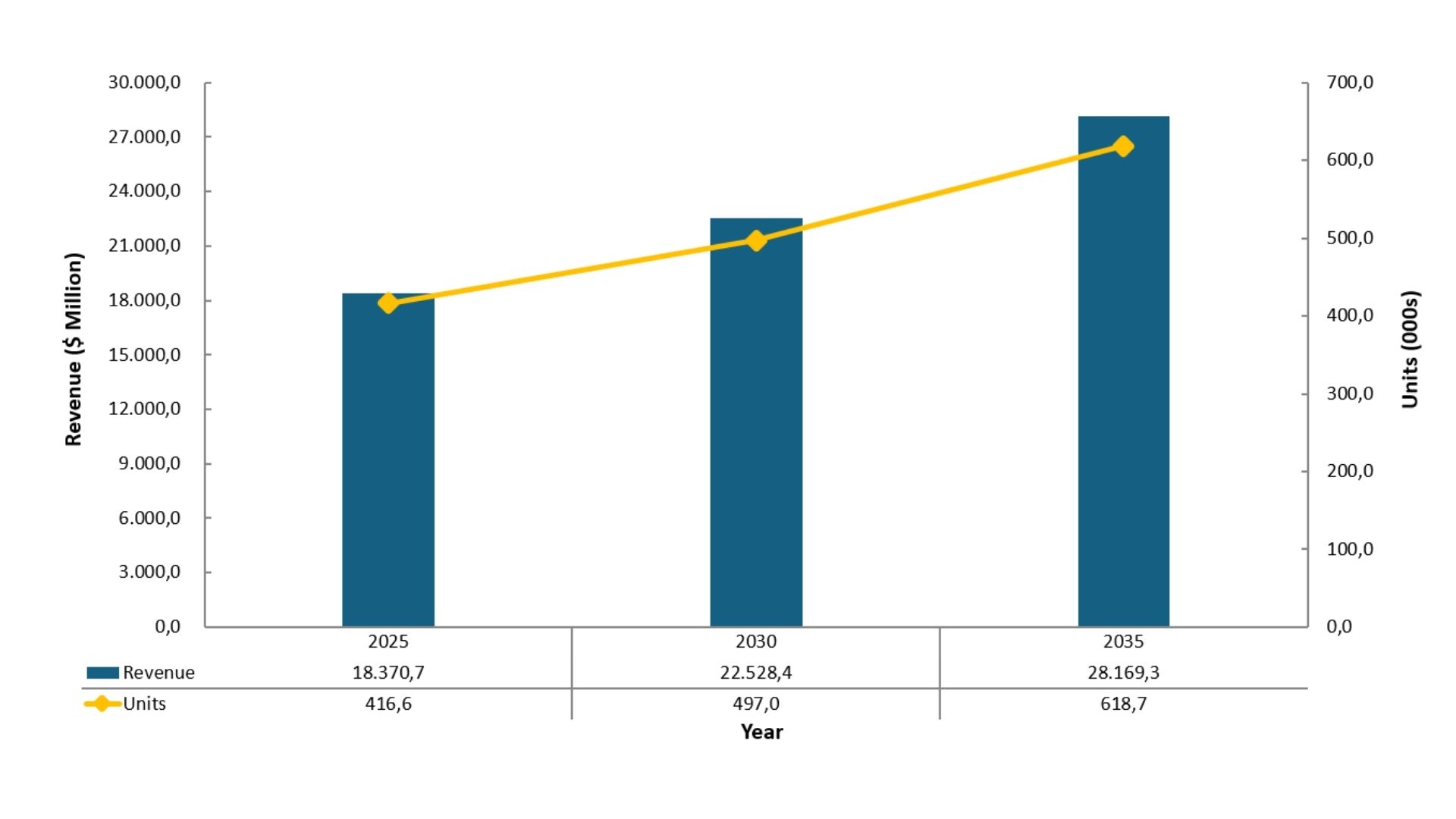
Frost & Sullivan analysis values the global genset market at approximately $18.37 billion in 2025, rising to $28.17 billion by 2035 at a compound annual growth rate of 4.4%. Beneath that steady growth is a more decisive shift: the technology mix, business models, and competitive rules of the industry are being rewritten at the same time.
Growth is Steady, but the Composition is Shifting
Unit shipments tell a parallel story. Global volumes stand at roughly 416,600 units in 2025 and expand at a 4.0% CAGR through the forecast period, with base year growth of 5.3%. Diesel remains the industry's foundation, accounting for 82.8% of 2025 revenue and reaching $23.09 billion by 2035 at a 4.3% CAGR. Yet the momentum sits elsewhere. Gas units, at 17.1% of revenue in 2025, are forecast to reach $5.08 billion by 2035 at a faster 4.9% CAGR. Diesel units still represent 64.6% of total volume in 2035, which confirms that the transition is directional rather than abrupt.
For building operators, this transition is relevant above all in the context of resilient energy supply. As the requirements placed on commercial buildings, healthcare facilities and data centers grow, backup power is becoming part of a broader strategy that combines availability, emissions considerations and digitally managed operations.
Gensets: Revenue Forecast by Fuel, Global, 2025, 2030, and 2035
Regionally, value and volume are moving on different tracks. North America is projected to hold a 30.8% revenue share by 2035, while China and ASEAN combined account for 26.4% of the market. Mature markets are paying for reliability and compliance, while emerging markets are expanding access to power.
The Forces Driving Transformation
Frost & Sullivan identifies four underlying forces reshaping the industry: sustainability, digitalization, decentralization, and new business models. Each is already visible in commercial practice, including in the way power supply is planned, monitored and managed in larger buildings and critical facilities.
Renewables are set to supply 45% of the global electricity mix by 2030, which repositions the genset from a standalone power source to a balancing asset within a hybrid system. Hybrid architectures that pair generators with solar and storage are being deployed to cut fuel consumption and extend runtime in off grid environments. In commercial buildings and data centers, similar approaches can support a more integrated view of on-site generation, storage and backup capacity.
At the same time, IoT enabled remote monitoring now delivers predictive maintenance alerts, real time performance analytics, and fuel optimization insight to fleet operators. These connected capabilities are also increasingly relevant for facility and energy managers seeking better visibility of critical power assets. Low emission engines and compatibility with natural gas and biodiesel are positioning gensets as a transitional technology that bridges conventional generation and sustainable energy.
Competitive intensity remains moderate. More than 50 competitors generate revenue above $10.0 million, but a small group of global leaders, including Caterpillar, Cummins, Generac Power Systems, and Rehlko, holds the majority of market share. Their strategic priorities are consistent: emissions compliance, digital integration, fuel flexibility, and hybrid diesel solar systems.
Where the Demand Sits: Offices, Commercial Buildings, and Data Centers
Demand is increasingly concentrated in power-intensive buildings and digital infrastructure. Across data centers, healthcare facilities, and office buildings, power consumption ranks as a high-impact growth driver for the genset industry across every forecast horizon, from the next one to two years through the next decade. Rising commercial and industrial consumption is sustaining demand for units above 300 kW, while 5G, edge computing, and growing requirements for data storage, security, and speed continue to lift data center investment.
North America illustrates the concentration most clearly. Data centers account for roughly 27.6% of regional diesel genset revenue and 25.4% of gas genset revenue in 2025, making the segment the single largest contributor to gas revenue in the region. Office buildings add a further 6.5% of gas revenue and 3.5% of diesel. United States revenue is forecast to rise from $4.93 billion in 2025 to $7.73 billion by 2035 at a 4.6% CAGR, supported by an extensive industrial base and expanding data center infrastructure.
The pattern repeats elsewhere. In Europe, industrial demand has traditionally dominated, but data centers are now a serious challenger on revenue and will overtake industrial before the end of the decade, with growth coming from both hyperscale and modular facilities. In China, cloud and colocation expansion tied to AI workloads is stimulating demand for units above 300 kW and particularly above 1 MW, while commercial, public, and infrastructure spending sustains demand above 500 kW.
For manufacturers, the implication is that product requirements are widening rather than narrowing. Hyperscale sites need high-capacity, mission-critical units. Edge and micro facilities need compact modular solutions. Office and commercial buildings need quieter, lower-emission units that can satisfy urban planning requirements and sustainability commitments. The ability to serve these demand profiles from a coherent platform will increasingly shape product strategy.
For building stakeholders, the key question is how these assets can be embedded in a resilient and connected infrastructure. Gensets need to work alongside building-management systems, energy-management platforms and other on-site energy assets, while providing operators with reliable status information and clear maintenance processes.
Three Growth Opportunities Worth Acting On
Cloud Integrated IoT Solutions
Connected assets enable predictive maintenance, remote control, and performance optimization, but they also expose operators to more devices, platforms, and security risks. Manufacturers should collaborate with cloud service providers on hosted applications that accelerate feature rollout, then extend the offer with billing history tracking, energy consumption forecasting, continuous security enhancements, and flexible usage terms that convert equipment sales into recurring relationships.
For commercial building and data center operators, these capabilities can support more transparent monitoring of critical power systems and better coordination with wider facility operations.
Strategic Collaboration for Market Expansion
Manufacturers with heavy international exposure are more vulnerable to geopolitical disruption than regionally focused peers. Partnerships between global and local players can reduce that exposure. Global OEMs gain local industry knowledge and field presence, while domestic partners gain capital and technology transfer. Alliances with local component producers and established government projects offer a practical route to market entry.
Innovative Product Development for Data Centers
Data centers are among the largest and fastest-growing end-user segments globally, while edge and micro facilities are generating demand for compact, modular genset solutions. Manufacturers should partner with technology firms and data center construction companies to deliver integrated packages, consider acquisitions that add disruptive capability, and scale research into advanced energy storage and liquid cooling.
The Strategic Imperative
The genset industry will grow, but value capture will depend on who leads in hybridization and digitalization.
Timing is critical. Frost & Sullivan rates the pace of technical change in the genset market at 7 out of 10, a high score for an industry often viewed as mature. By around 2030, diesel technologies will reach maturity and advantage will shift toward fuel-flexible, connected platforms. The action window is 1 to 3 years, not a full product cycle.
This compression favours companies that move faster than scale alone allows. As customer requirements become more segmented across standby, prime, hybrid, and digitally managed applications, advantage now sits with players that combine emissions compliance, digital services, and local market access.
Growth is no longer about adding capacity. It is about building an adaptive model that connects cleaner fuels, digital services, and local execution into a stronger competitive position. In commercial buildings and critical infrastructure, the same shift points towards more integrated, connected and transparently managed backup-power systems.
Download
Download additional insights and market data on the global genset market to better understand market movements, identify trends early, and support strategic decisions with a solid evidence base.