Get a quick and up-to-date overview of the developments in the field of intelligent building technology. The content is customizable to your interests, presented in a neutral manner, and created by experts for experts.
Wellness Engineered: The Technology Behind Hotel Pools and Spas
14 Jul 2026
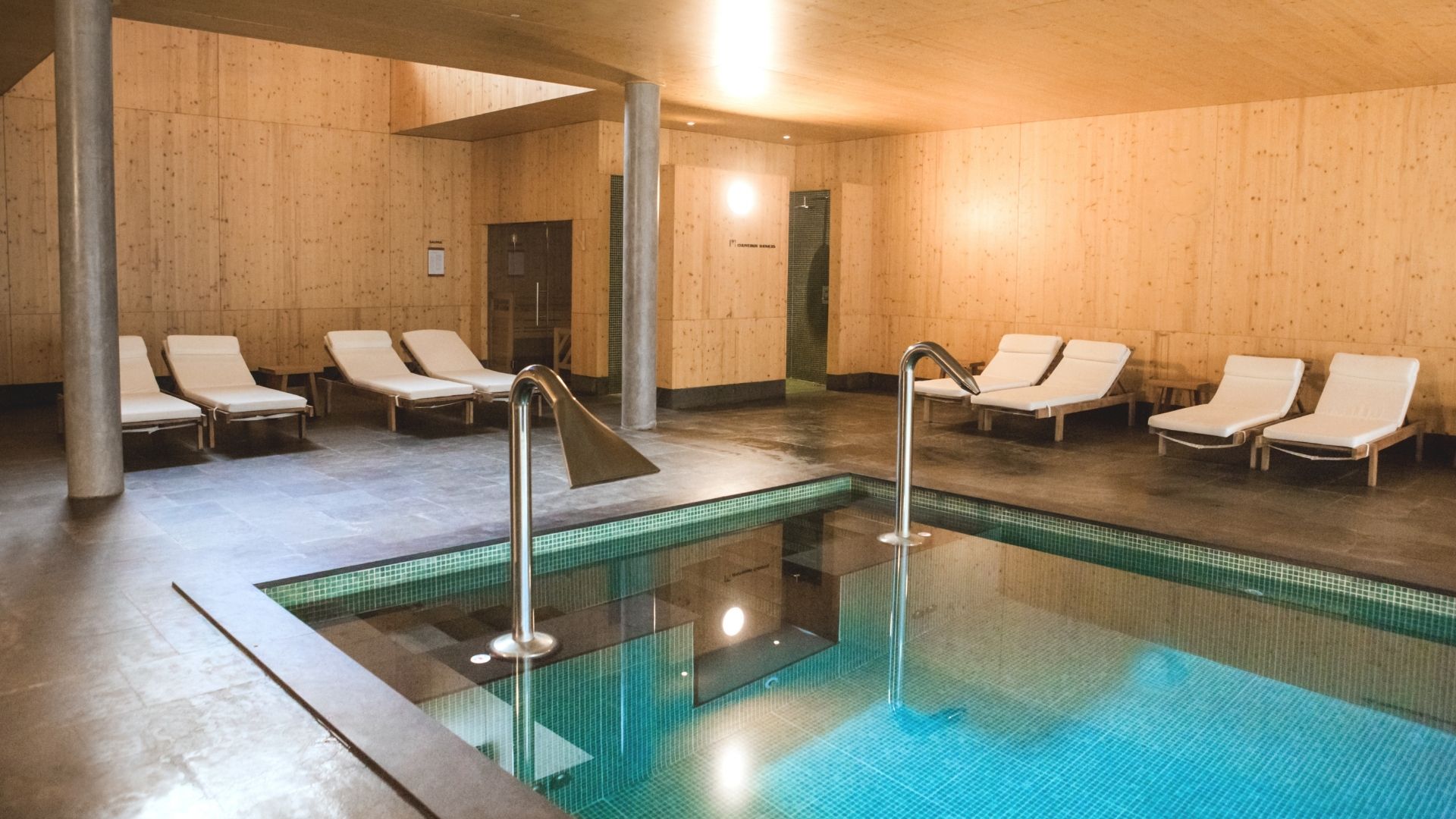
Pools and spas are no longer just a luxury extra. They determine a property's competitive positioning. As a result, requirements are increasing: ventilation, heating, cooling, water treatment, bathroom installations, and energy technology must function as a networked system.
Pool and spa areas are a strategic differentiator for hotels and premium properties, but they are also technically complex.
Ventilation, dehumidification, heating, cooling, water treatment, sanitary systems, and renewable energy must be planned and controlled together.
Indoor air technology is central because evaporation, humidity, chlorine exposure, and condensation risks place specific demands on systems and materials.
Intelligent building automation connects technical systems, optimizes energy use, supports hygiene requirements, and enables monitoring, alarm management, and reporting.
Standards such as VDI 2089, DIN 19643, TrinkwV, DVGW W 551, and DIN 18040-1 provide the framework for safe, hygienic, and accessible operation.
A hotel pool is not a swimming pool. It is a promise. A promise to the guest seeking relaxation after a long day of travel, to management needing differentiating factors in a competitive market, and to the operator who must ensure this space functions around the clock — hygienically sound, energetically justifiable, and technically reliable. Anyone planning or operating a hotel pool or spa facility moves at the intersection of multiple trades: building automation, ventilation, heating, cooling, water treatment, pool technology, and renewable energy. How these trades interact — and what happens when they don't — is the subject of this article.
"Operators today expect solutions that bring together energy efficiency, water quality, and guest comfort. That intersection is precisely where we focus at the Pools & Spas area at ISH 2027."
Pool and Spa as a Strategic Building Function
Just two decades ago, an indoor pool in a hotel was considered a pleasant add-on — one that could be operated without full capacity utilization if necessary. That perspective has fundamentally changed. Comparison platforms and review portals have turned wellness offerings into a measurable booking factor. According to analyses of the international hospitality market, pool and spa facilities now rank among the five most frequently cited amenities in booking decisions in the upper price segment.
At the same time, the spectrum of use has expanded considerably. Indoor pools and spa areas are no longer conceived merely as leisure facilities, but as spaces for rehabilitation, corporate health promotion, and medically oriented recovery programs. This places new demands on operations and technology: process-oriented building management is required, as medically used pools are subject to different standards than recreational facilities.
The Trade Network: Why Integrated Thinking Is Essential
Pool and spa areas are among the most technically demanding zones in any residential complex or hotel. Unlike an office building or a standard residential property, multiple conditioning requirements converge simultaneously:
High latent loads from water evaporation influence ventilation design
Water temperatures of 28–36°C (82–97°F) generate constant thermal loads on heating and cooling systems
Chlorine and ozone concentrations in the room air place particular demands on materials, filters, and exhaust systems
Water treatment, Legionella prevention, and hygiene monitoring require independent yet integrated control circuits
Energy demand and the carbon footprint of overall operations require the integration of renewable energy sources
When these trades are planned and operated in isolation, friction losses, inefficient operating patterns, and elevated maintenance costs arise. When they interact as a networked system, the result is an operation that is simultaneously more economical, hygienically safer, and more comfortable for the guest.
Air Quality and Ventilation — The Invisible Core
The dominant air-side influence in an indoor pool is water evaporation. Open water surfaces, moving water (whirlpools, counter-current systems, water features), body heat from bathers, and wet surfaces around the pool basin continuously generate humid air. The consequences: latent heat loads that quickly push conventional air conditioning systems to their limits, and condensation risks on building structures that can lead to long-term structural damage.
The primary international reference for ventilation design in indoor pool environments is ASHRAE Standard 62.1 (Ventilation and Acceptable Indoor Air Quality), which defines requirements for air volumes, distribution, and dehumidification performance. For facilities with European operations, EN 16798-1 provides the equivalent framework. Many jurisdictions also reference VDI 2089 for pool-specific guidance on supply air concepts and moisture loads.
Concept
Characteristics and Typical Application
Displacement ventilation
Supply air introduced at low level or via floor outlets; gentle, draught-free air distribution; particularly suited to high-end wellness areas
Mixed Air System
Conventional dilution ventilation; lower cost, but more susceptible to draughts and less precise in dehumidification
Dehumidification unit (heat pump)
Condensation dehumidification with integrated heat recovery; high energy efficiency; standard in modern hotel facilities
Hybrid System
Combination of dehumidification heat pump and controlled fresh air mixing; enables seasonal optimization and minimal operating costs
Table: Comparison of swimming pool ventilation concepts
Chlorine Resistance and Material Requirements
The chemical load on room air in chlorinated pools places particular demands on equipment and materials. Heat exchangers, fans, duct linings, and filters must be manufactured to be chlorine-resistant — often from stainless steel or specially coated aluminium alloys. Cutting corners in the planning phase leads to elevated maintenance costs and premature system failure.
Ozone-based water treatment systems, increasingly deployed as an alternative or supplement to chlorine, additionally require verifiable residual ozone decomposition in the exhaust air before it is discharged to the outside — another requirement that must be accounted for in ventilation planning.
Heating and Cooling - Energy Management Under Extreme Conditions
The energy demand of a hotel spa area exceeds that of almost any other part of the building on a net floor area basis. Pool heating, hot water supply for showers and baths, steam generators for steam rooms, sauna units, underfloor heating in wet areas, and supply air heating combine to create a load profile that, without a strategic energy concept, becomes a significant cost driver.
At the same time, this area offers significant heat recovery potential: the warm, humid exhaust air from an indoor pool carries unused thermal energy to the outside in conventional systems. Heat recovery systems — cross-flow heat exchangers, rotary heat exchangers, or heat pumps — can recover 50–75% of this energy depending on configuration, and redirect it for pool water or fresh water heating.
Heat Pumps as a Key Technology
Modern pool heat pumps can simultaneously dehumidify, maintain room temperature, and heat pool water — three functions in one system that older plant concepts required three separate units to achieve. For hotel operators, this means lower capital expenditure, reduced maintenance effort, and a unified control circuit that integrates into building automation.
For new builds and major refurbishments, coupling the pool heat pump with an overarching heating and cooling strategy is recommended — one that accounts for seasonal outdoor temperatures, internal loads, and the hotel's occupancy situation.
Water Treatment, Hygiene, and Legionella Prevention
Legionella are bacteria that find ideal growth conditions in hot water systems at temperatures between 25°C and 50°C (77–122°F). Inhaled water vapour — from whirlpools, steam rooms, showers, and mist showers — is the primary transmission route for Legionnaires' disease. For hotels and bathing facilities, this means: domestic water hygiene is not an optional measure but a legal obligation with direct liability consequences.
The internationally recognized framework for Legionella risk management in buildings is WHO Technical Memorandum on Legionella, alongside national equivalents such as the UK HSE ACoP L8 (Legionnaires' Disease: The Control of Legionella Bacteria in Water Systems), the European ECDC guidelines, and local regulatory requirements. Core requirements typically include:
Hot water storage temperature: minimum 60°C (140°F) at the calorifier outlet
No cooling below 50°C (122°F) in the circulating pipework
Regular sampling and documentation for Legionella pneumophila
Technical inspection of the overall system and risk assessment
Elimination of dead legs and infrequently used pipe sections (stagnation protection)
Intelligent building automation can make meeting these requirements significantly easier: temperature sensors in all relevant pipe sections, automatic flushing programs for stagnation zones, and digital logging of all measured values create not only hygienic safety but also the auditable evidence required by authorities and insurers.
Pool Water Treatment: From Chlorine to UV
Pool water treatment is an independent technical system, yet closely interlinked with ventilation, heating technology, and building automation. Common treatment methods and their characteristics:
Method
Characteristics and suitability for hotel use
Chlorination (free halogen method)
Established standard method; cost-effective; requires precise dosing control; chloramines can irritate the eyes and respiratory tract
UV disinfection
Can be combined with residual chlorine; reduces chloramine formation; noticeably improves water quality; higher investment costs
Ozonation
Highest treatment quality; residual ozone must be controlled and broken down; demanding ventilation requirements
Electrolytic disinfection (saltwater)
Chlorine generation directly from common salt; gentle on skin and eyes; growing demand in the premium segment
Combined method (UV + chlorine)
Best practice for high-quality hotel facilities; minimizes chemical use and maximizes water quality
Table: Pool water treatment methods
Normative framework: The primary international reference for pool water quality is the WHO Guidelines for Safe Recreational Water Environments, Volume 2: Swimming Pools and Similar Environments, which defines limits for turbidity, microbial counts, free chlorine, combined chlorine, and pH value, as well as acceptable treatment processes and testing intervals. In Europe, EN 16713 series standards apply alongside national regulations.
Pool Technology and Plumbing in the Spa Area
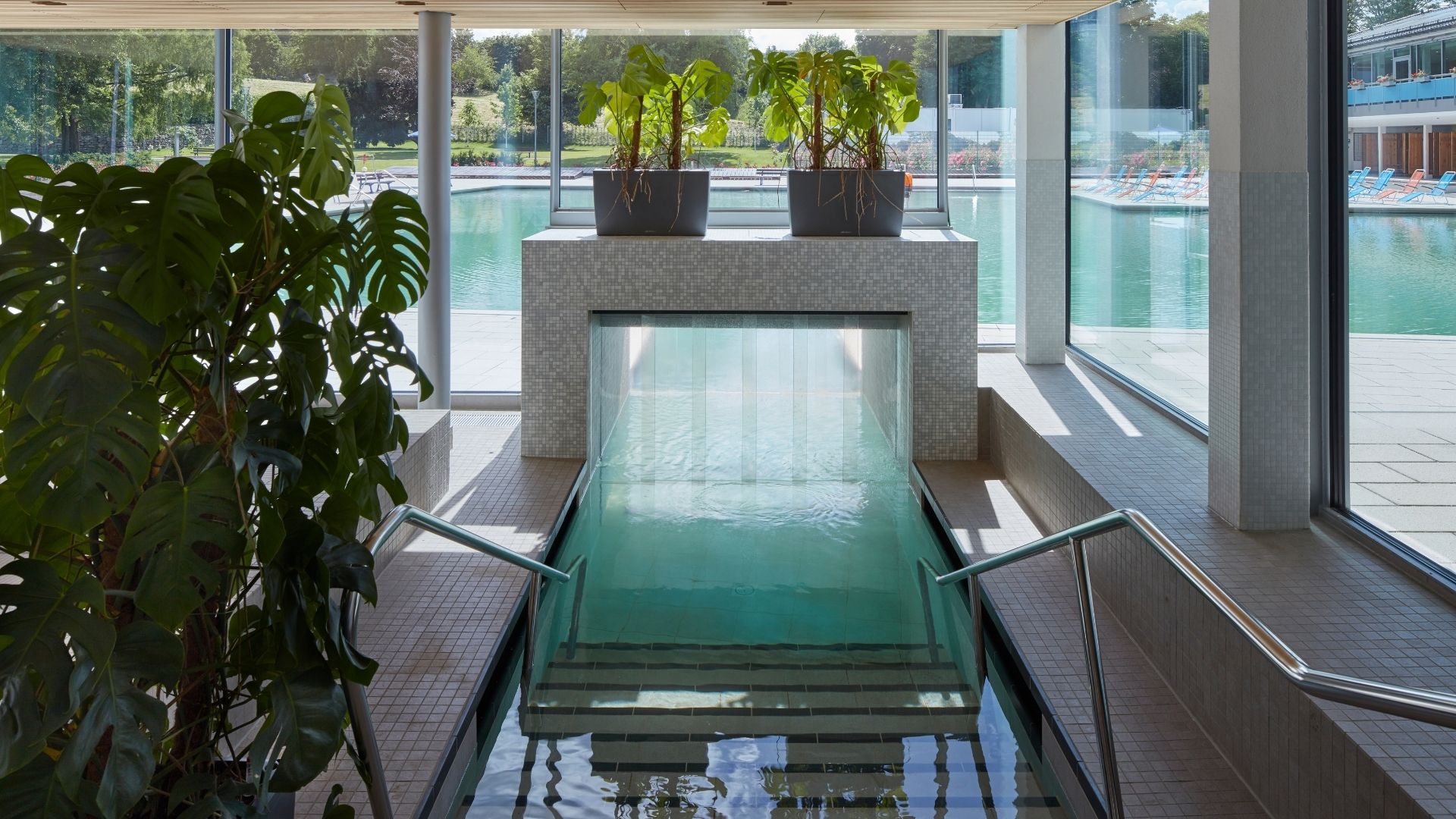
A hotel spa encompasses a dense collection of water-based installations: pools, whirlpools, cascade and Kneipp showers, steam rooms, ice fountains, footbaths, outdoor loungers with water connections, and changing rooms with showers and washbasins. Each of these installations requires specific installation planning that goes well beyond standard plumbing.
Key planning aspects for spa plumbing include:
Pipework routing with fall and drainage provision for all dead legs (Legionella protection)
Pressure-stable supply even during simultaneous use of multiple draw-off points (hydraulic balancing)
Softening or scale inhibition systems for hard water regions (scale deposits in heat exchangers and nozzles)
Floor drains and drainage channels with high discharge capacity, corrosion-resistant and slip-resistant (per EN 1253)
Touchless fittings (contactless or sensor-controlled) as a hygiene contribution and comfort feature
Separate pipework circuits for potable water, process water (pool water), and grey water (where recirculation is planned)
Accessibility as a Design Obligation
Wellness and therapy are increasingly relevant for older guests and people with reduced mobility. ISO 21542 (Accessibility and Usability of the Built Environment) and its national equivalents define minimum requirements for accessible washbasins, level-access showers with fold-down seats, grab rail systems, and step-free pool access. Addressing these requirements in the planning phase avoids costly retrofitting and opens up a growing guest segment.
Renewable Energy in Pool and Spa Operations
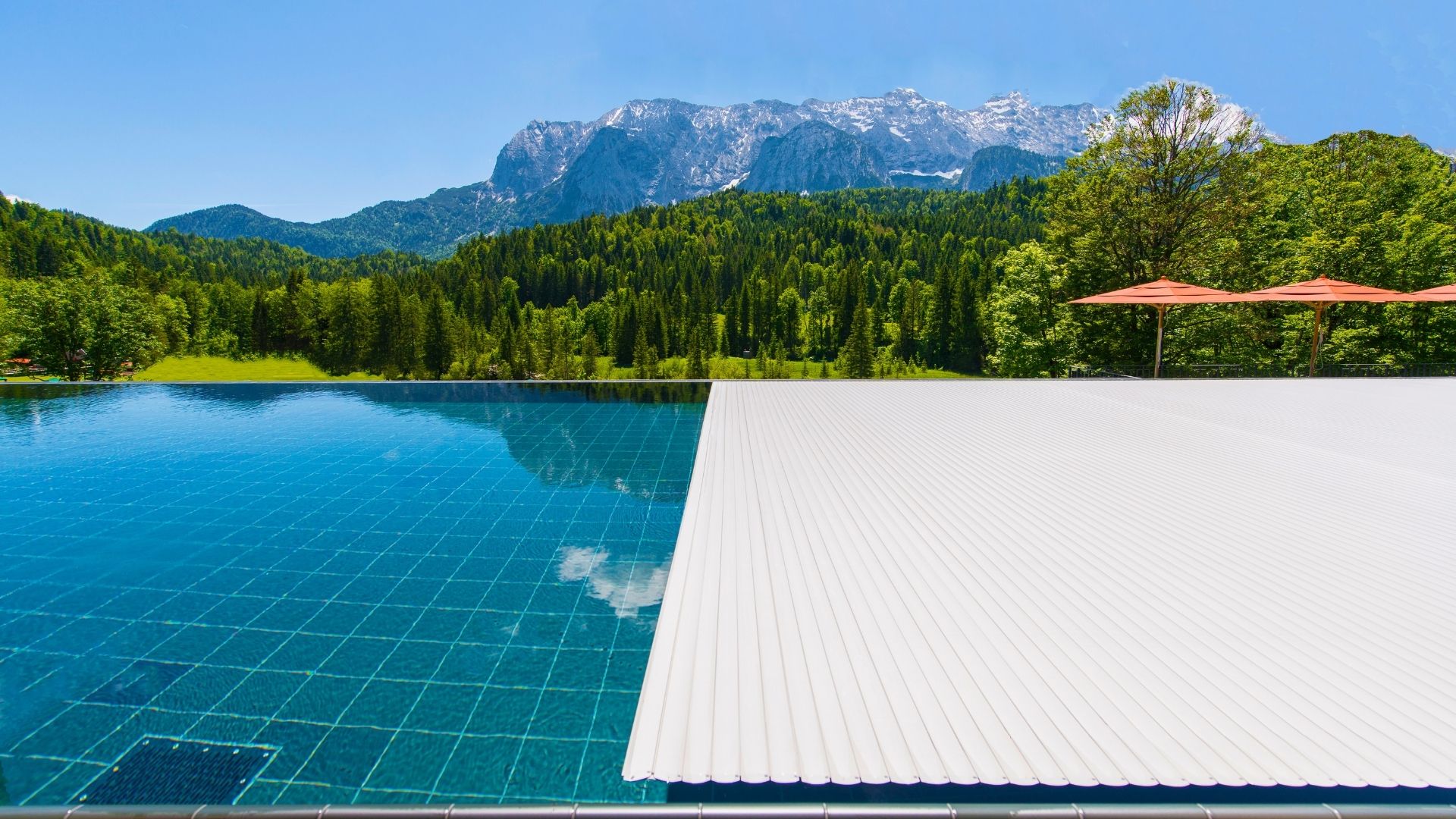
Hotel Schloss Elmau. Photo: Rollo Solar® Melichar GmbH
Solar Thermal: The Most Obvious Addition
Pools and spas have a characteristic that makes them ideal application fields for solar thermal systems: they have a high and largely continuous heat demand that correlates well with solar availability - at least during the main season. Thermal solar systems for pool water heating or domestic hot water support are therefore economically attractive in many hotel operations.
In addition, photovoltaic systems for on-site electricity generation are gaining importance. The electricity demand of heat pumps, filtration systems, pumps, and lighting in the spa area can be partially met by rooftop PV - reducing operating costs and improving the carbon footprint, which is increasingly relevant both as a marketing argument and as an ESG metric.
Environmental Heat Pumps: Waste Heat, Groundwater, Air
For hotels in urban locations or without large roof areas, alternative heat sources are available. Waste water heat recovery is particularly efficient in hotels with high hot water consumption and typically amortizes within three to seven years. Groundwater heat pumps or borehole ground source heat pump systems achieve COP values of 4 to 6 and substantially reduce primary energy demand - though they presuppose appropriate hydrogeological and permitting conditions.
Biomass heating systems or district heating connections can serve as base load systems, supplemented by heat pumps for peak loads. The overall system design is decisive: which source delivers which proportion at which temperature level, and how are these sources coordinated by an overarching energy management system?
Building Automation: The Nervous System of an Integrated Spa Operation
All the trades described above — ventilation, heating, cooling, water treatment, plumbing, and renewable energy — only realize their full potential when coordinated by an overarching building automation (BA) system. A hotel spa in which the ventilation system, pool water heating, and solar installation operate as independent islands forfeits efficiency potential and elevated operational reliability.
An integrated BA system based on established protocols (BACnet, KNX, Modbus) connects all control circuits into a single system and enables:
Load-responsive control: Ventilation capacity, heating circuits, and hot water preparation automatically adapt to occupancy level and time of day
Automatic night setback: During non-operation, pool water temperature, room air temperature, and supply air volume are reduced to minimum levels without violating hygiene requirements
Legionella thermal disinfection programs: Automatically triggered heating of all pipe sections to 70°C (158°F) at prescribed intervals
Energy management and reporting: Real-time consumption data, trend analyses, anomaly detection, and automatic generation of maintenance orders (interface to CAFM systems)
Remote access and alarm management: 24/7 monitoring by the operator or service provider; immediate escalation on critical deviations (e.g. temperature drop in hot water circuit, chlorine levels outside set values)
Modern BA systems extend beyond the building services interface. In the hospitality context, they increasingly incorporate guest-oriented controls: room temperature and lighting in relaxation areas can be adjusted via app or touch panel; booking systems can be linked to technical controls so that a reserved private spa suite is automatically preheated to the right temperature before the guest arrives.
This creates not only comfort but also energy savings: rather than conditioning a space continuously, it is only brought to operating level when there is an actual demand for use.
Best Practice: Best Practice: Integrated Building Automation System in a Hotel Spa
BACnet backbone connecting ventilation system, pool water heating, solar installation, and domestic water system in a single system
Automatic thermal disinfection programs per WHO/HSE L8 guidelines, documented and audit-ready
Occupancy-based control: 30% energy saving compared to constant operation
Real-time alarming on deviation from chlorine, temperature, or humidity set values
Guest app with preferred temperature and lighting control for booked private spa suites
Monthly energy reports as the basis for ESG reporting and certification (e.g. Green Key, EU Ecolabel, LEED, BREEAM)
Regulatory Framework: What Hotel Operators and Planners Need to Know
The operation of pools and spas in hotel settings is governed by a range of standards, regulations, and guidelines that place varying levels of requirement depending on the facility type and use.
Standard/Framework
Relevance for Hotel Pool and Spa
WHO Guidelines for Safe Recreational Water Environments (Vol. 2)
Pool water quality; microbial and chemical limits, treatment processes
ASHRAE 62.1 / EN 16798-1
Indoor air quality; ventilation design requirements
HSE ACoP L8 / ECDC Legionella Guidelines
Legionella prevention; temperature requirements, sampling obligations
EN 15288
Safety requirements for public swimming pools
ISO 21542
Accessible and inclusive built environments
EPBD (EU Energy Performance of Buildings Directive) / local equivalents
Primary energy requirements for new builds and major renovations
EN 16713 series
Pool water treatment and recirculation systems
EN 1253
Floor drains for buildings; drainage performance and corrosion resistance
LEED / BREEAM / Green Key
Voluntary sustainability certification frameworks increasingly required by investors and operators
ISH 2027: The Meeting Point for Planning and Operations
ISH 2027 (15–19 March 2027, Frankfurt am Main) addresses precisely this complexity. The newly created Pools and Spas area in Hall 3.0 — developed in collaboration with the bsw (German Federal Association for Swimming Pools and Wellness), the DGfdB (German Society for Pool and Bathing Facilities), and the German Sauna Association — brings manufacturers, planners, operators, architects, and investors together in one place.
What makes it distinctive: the area is not conceived in isolation, but embedded within the full solution landscape of ISH. Immediately adjacent, visitors will find suppliers for water-bearing systems, indoor air quality and climate control, intelligent building management, energy-efficient heat generation, and sanitary technology. Around 45% of trade visitors travel from outside Germany — creating an international environment in which both global trends and regional regulatory differences can be explored.
For planners and hotel operators, ISH is therefore the ideal venue to close existing knowledge gaps at the intersection of trades, prepare concrete projects, and evaluate suppliers and planning partners in a single environment.
A hotel pool or spa that truly works — for guests, for operations, and financially — is not a product. It is the result of consistently integrated planning, in which ventilation, heating, water treatment, plumbing, and renewable energy are conceived not as separate trades but as components of a networked system. Building automation is not the end point of this integration — it is its backbone. And the standards governing this field are not obstacles but a quality promise: to the guest, to the operator, and to society.
Dr Heiko Baumgartner
Freelance journalist with a strong focus on life science, security and chemistry.
Thanks to his extensive experience as Publishing Director at a leading international science publisher and his expert knowledge as Editor-in-Chief in various specialist editorial offices, Heiko Baumgartner builds a bridge between innovations and technologies and their practical applications.