
Reading time: 7 minutes
Key Takeaways
- Emotionally smart spaces add a new layer to smart buildings: buildings should not only operate efficiently, but actively support human experience, health, safety, and well-being.
- Sensors, spatial data, and adaptive systems capture environmental factors such as air quality, light, noise, temperature, occupancy, and wayfinding — and translate them into people-centered responses.
- Strategic value does not come from more data alone, but from interpretation: spaces need to identify whether conditions create stress, uncertainty, overstimulation, or exclusion.
- Inclusive design becomes essential because comfort, safety, and sensory needs vary by age, gender, health, neurodiversity, culture, and situation.
- The next generation of intelligent buildings will be defined by how effectively they turn data into measurable improvements in comfort, trust, orientation, and belonging.
Smart buildings are increasingly defined by sensor networks, connected controls, and adaptive systems. Yet the next strategic shift is not more automation, but a different form of intelligence: environments that interpret signals from human use, indoor conditions, and spatial behavior to support comfort, health, trust, and emotional well-being.
These environments move beyond purely technical optimization. Air quality, light, sound, thermal comfort, spatial legibility, and perceived safety are not neutral variables, but conditions that directly shape how people function within space. Research in neuroarchitecture and built environment perception shows that spatial environments influence cognition, stress regulation, attention, and behavior.
Connectivity as Emotional Infrastructure
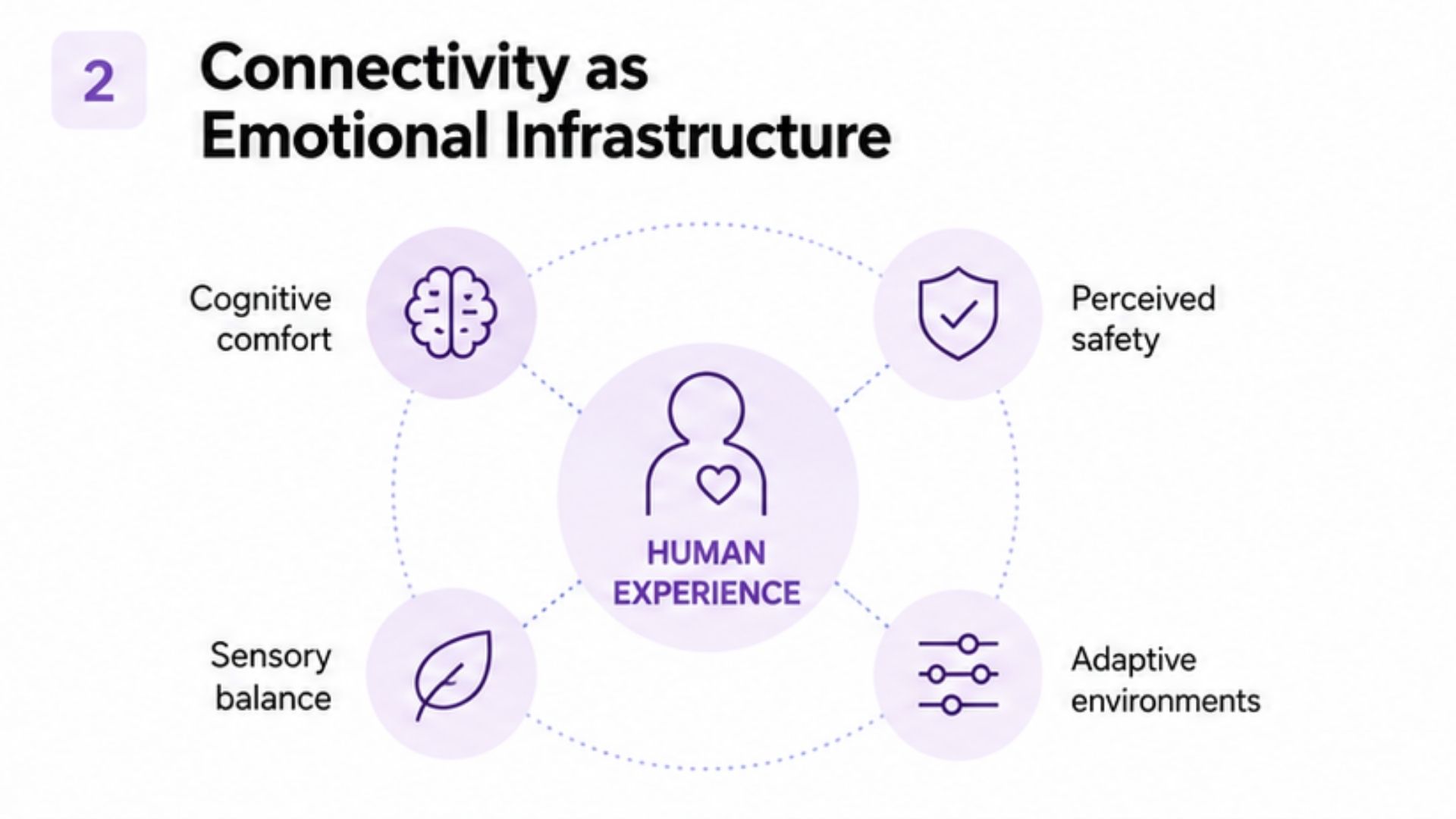
In conventional smart building models, connectivity links devices, systems, and operational data. Here, it extends further, connecting environmental signals with human experience. Indoor environmental quality monitoring already captures temperature, air quality, humidity, occupancy, and lighting in real time. The relevance of these variables lies not only in system performance, but in their impact on usability, stress, and well-being.
The strategic change is that these signals should no longer be used only for energy optimization or maintenance efficiency. They should also be used to ask whether the space is overstimulating, disorienting, exclusionary, stressful, or socially unsafe for certain users. WHO’s housing and urban health guidance explicitly links the built environment to health equity, mental well-being, and the needs of different population groups, including children, older people, and migrants.
This makes connectivity an emotional infrastructure. Sensors detect conditions, digital systems identify patterns, and environmental controls translate those patterns into spatial responses. The value is not the sensor itself, but whether the connected system improves lived experience in a measurable and trusted way. NIST’s smart building work and WHO’s cross-sector mental health guidance both support this move from purely technical management toward healthier, more human-centered environments.
From Smart to Emotional: A System Shift
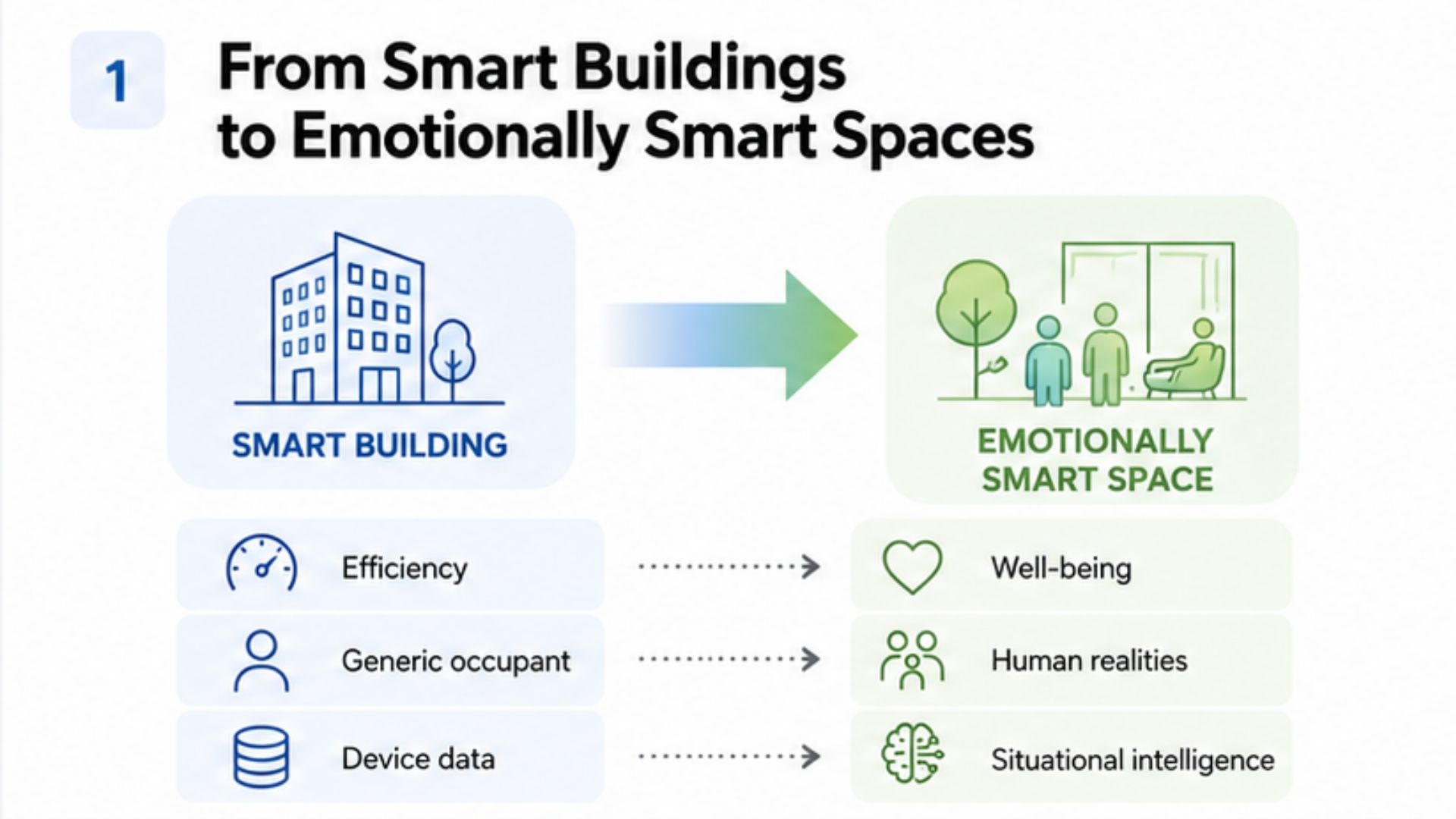
The difference between a smart space and an emotional smart space is not simply one of technology level. It is a shift in design logic. Standard smart environments often optimize measurable operational variables such as occupancy, energy use, or fault detection. Emotionally smart spaces still do that, but they also recognize that environmental inputs become meaningful only when interpreted in relation to human well-being, accessibility, and psychological comfort.
This shift aligns with the broader move in built environment thinking from standardization toward more adaptive and post-demographic design. The trend materials already point toward post-demographic and real digital models in which buildings and cities respond less to fixed social categories and more to changing life situations and patterns of use.
In practice, this means that an emotionally intelligent building does not only “know” that a room is occupied. It can also recognize recurring conditions associated with discomfort or stress, such as poor ventilation, glare, acoustic overload, confusing circulation, or low perceived safety. Neuroarchitecture research supports this approach by showing that the built environment influences emotional and cognitive states through measurable physiological and psychological pathways.
Designing for Different Human Realities
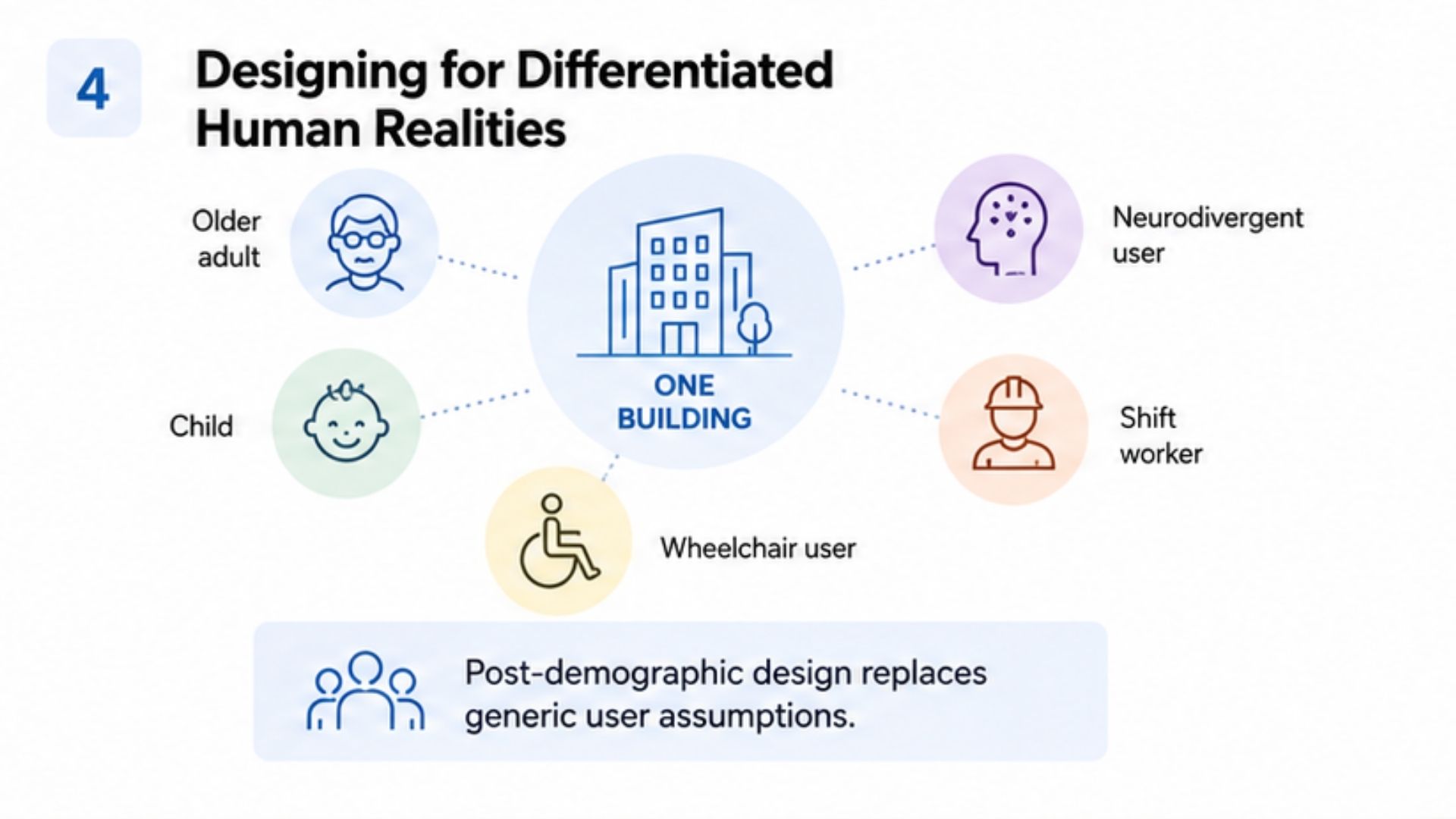
The biggest weakness of many smart building strategies is the assumption of a generic occupant. Emotionally smart spaces cannot be designed for the average user because comfort, safety, orientation, and sensory tolerance vary significantly across age, gender, health condition, disability, culture, and migration background. WHO, UN-Habitat, OECD, and related urban guidance repeatedly stress that inclusive public and built environments must respond to differentiated needs rather than a single norm.
Gender: Perception, Safety, and Control
Age-friendly design is one of the clearest areas where emotionally smart spaces can move beyond generic comfort models. WHO’s Age-Friendly Cities Framework identifies the built environment, transport, housing, participation, and inclusion as core areas of concern for older people. It emphasizes that age-friendly environments should anticipate different capacities rather than assume a uniform user profile.
Within this framework, comfort and usability are closely linked to accessibility, safety, and ease of navigation. Predictable spatial organization, clear wayfinding, manageable environmental conditions, and a sense of security are essential for supporting independence and daily functioning in older age.
This highlights a key limitation of standard building models, which often rely on uniform comfort assumptions rather than addressing differentiated user needs. In practice, this means smart spaces should not only automate heating or lighting, but adapt them in ways that reduce cognitive friction. Clear transitions, low sensory volatility, and accessible interfaces become as important as energy efficiency.
An emotionally smart space for older users is therefore not defined by automation alone, but by its ability to reduce uncertainty and support confident, stress-free use of the environment.
Gender-responsive design is often reduced to security hardware, yet spatial experience is shaped more fundamentally by perceived control, visibility, and freedom of movement. Evidence from urban safety research shows that the design of public space directly influences how safe people feel, particularly for women and girls.
For emotional smart spaces, this means detecting not only technical anomalies but also spatial conditions that undermine confidence. Low lighting, visually isolated circulation routes, dead zones, and poor sightlines are consistently identified as factors that negatively affect perceived safety and limit freedom of movement.
A mature approach combines lighting systems, occupancy sensing, and spatial analysis to support clearer and more predictable movement, especially in low-activity conditions. The objective is not surveillance, but to create environments that enable users to navigate space with confidence and autonomy.
Health, Neurodiversity, and Sensory Conditions
Health-responsive design extends beyond clinical environments. Air quality, thermal conditions, noise, and access to nature all influence both physical and mental well-being.
For neurodivergent users, the sensory profile of space becomes critical. Research on autism and the built environment highlights the importance of controlling sensory stimuli, particularly noise levels, environmental predictability, and access to low-stimulation areas in reducing stress and supporting usability.
Emotionally smart spaces can address this through sensor-based monitoring of noise, glare, crowding, and environmental fluctuations. Instead of applying a single comfort model, they enable different modes of occupation by maintaining sensory balance across diverse thresholds.
This is equally relevant for users with chronic illness, anxiety, or respiratory sensitivity, where environmental stability becomes part of preventive health.
Cultural Inclusion and Spatial Belonging
Spatial experience is also culturally mediated. Migration-informed design highlights that inclusion is not only about access, but about whether environments feel understandable and welcoming.
Language, spatial norms, visibility of social interaction, and degrees of openness all influence whether a space feels inclusive or alienating.
In emotionally smart spaces, this translates into adaptable interfaces, multilingual communication layers, and participation mechanisms that acknowledge different levels of familiarity and trust.
Cultural inclusion, in this sense, is not an additional feature. It is a condition for the operational legitimacy of connected environments.
From Demographics to Adaptive Systems
While these distinctions are essential, they are not fixed.
Post-demographic thinking shifts the focus from predefined user categories to changing life situations and patterns of use.
This reframes emotional smart spaces as adaptive systems:
- They respond to behavior rather than assumptions
- They learn from recurring patterns
- They evolve with changing needs
The result is not personalization in a narrow sense, but situational intelligence, where spaces adjust across time, activities, and user conditions.
From Data to Meaning
Smart environments already generate large volumes of data, but more data does not automatically produce better spaces.
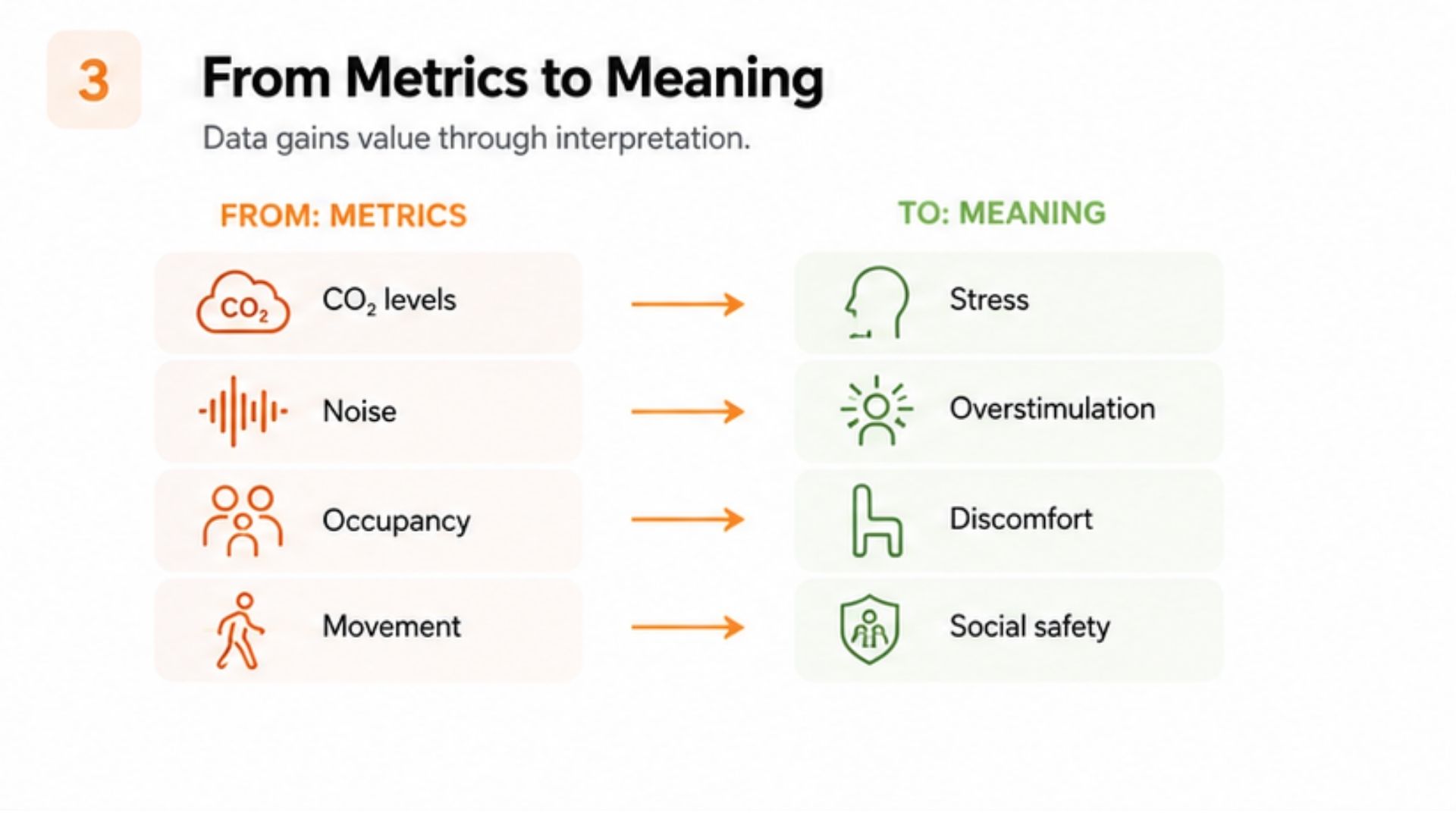
Environmental signals such as CO₂ levels, noise peaks, or underused areas are often treated as technical metrics. In reality, they can indicate discomfort, stress, or spatial avoidance.
Emotionally smart spaces introduce a meaning layer that connects these signals to human experience. They not only monitor conditions, but also interpret what those conditions imply for usability and well-being. This shifts buildings from data-driven systems to interpreting environments.
Nature as Emotional Infrastructure
Emotional intelligence in space is not purely digital. Access to nature plays a central role in regulating stress, improving mental health, and supporting well-being. Daylight, vegetation, views, and microclimatic conditions shape how environments are experienced.
Emotionally smart spaces integrate these elements as active design parameters. Adaptive shading, daylight balancing, and green spatial systems become part of the same responsive logic as digital controls. The most advanced environments do not separate technological and ecological intelligence.
Limits: Trust, Bias, and Responsibility
Introducing emotional responsiveness into buildings increases both capability and risk.
- Data becomes more sensitive as systems interpret behavior
- Bias can emerge if systems reflect limited user profiles
- Adaptation without transparency can reduce trust
For this reason, emotionally smart spaces depend on clear data boundaries, transparency, and user awareness.
Their success is not defined by how much they can infer, but by whether users understand and trust how systems operate.
Emotional Smart Spaces as Strategy
Emotionally smart spaces connect multiple agendas that are often treated separately: smart buildings, health, inclusion, and user experience.
They introduce a new performance layer, where buildings are evaluated not only by efficiency, but by how they support comfort, safety, and belonging.
This shifts the competitive value of buildings and urban systems. The question is no longer how much technology is integrated, but how effectively systems translate into meaningful human experience.
Next Steps
They position buildings not only as systems that operate, but as environments that continuously interpret and respond to human experience. By connecting environmental data with perception, they enable spaces to adapt not just to conditions, but to changing patterns of use.
In increasingly complex and diverse contexts, this shift becomes decisive. The success of connected environments will not be determined by system performance alone, but by their ability to support usability, safety, and inclusion across different users and situations.
Ultimately, the next generation of buildings will not be defined by how much data they process, but by how effectively they translate that data into meaningful, human-centered outcomes.