
Reading time: 3 minutes
Commercial buildings are getting smarter at sensing — but not at acting. Across companies active in building AI today, a consistent pattern emerges: detection capabilities are maturing rapidly while the workflow integration needed to turn those signals into coordinated action remains underdeveloped.
A Structural Gap, not a Technology Gap
This gap is not a technology problem. The components exist. What is missing is the ability to combine them reliably across the heterogeneous mix of legacy systems, hardware, and protocols that define real commercial buildings — and that gap is quietly reshaping where competitive advantage in the sector actually sits.
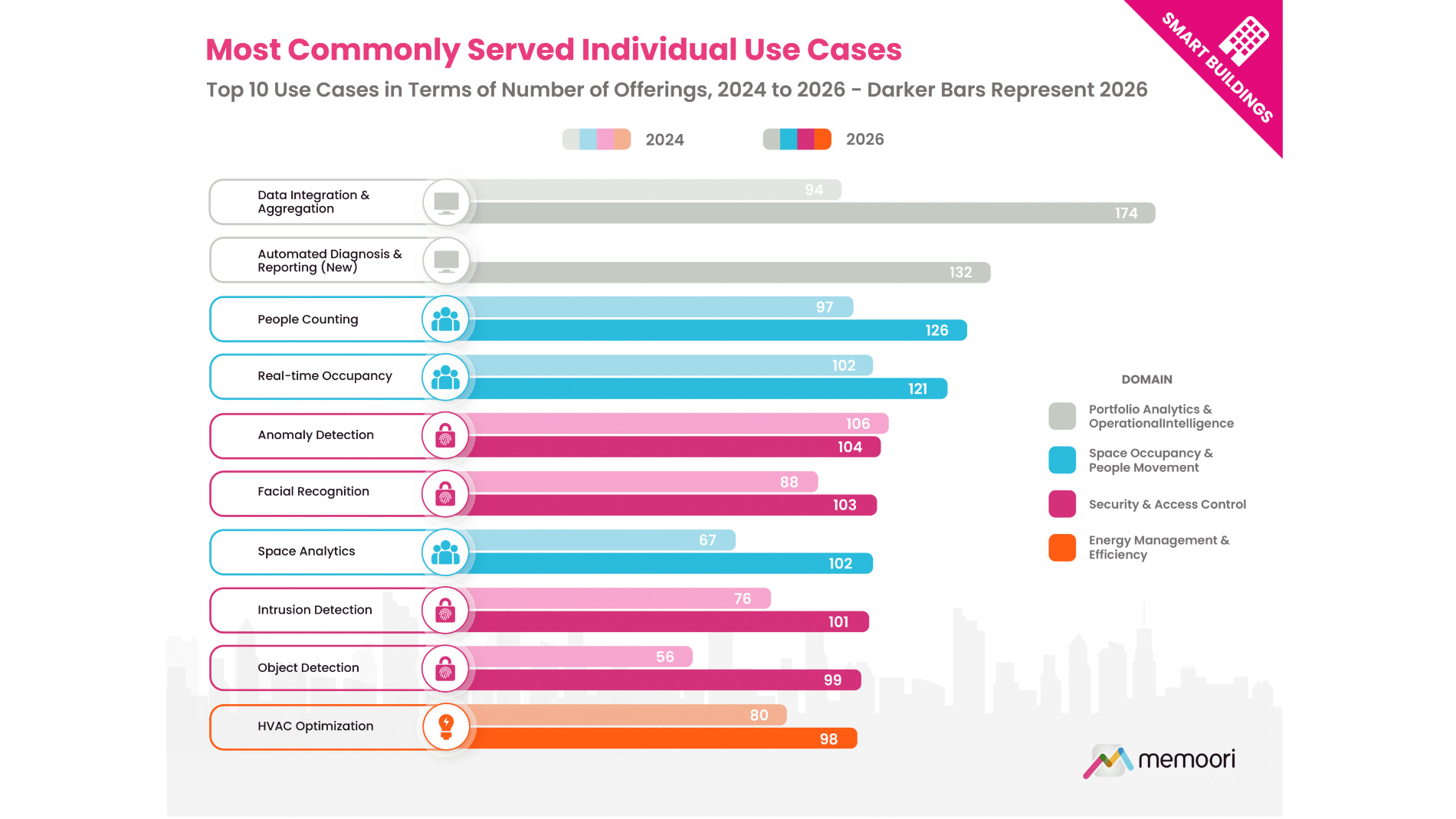
In Indoor Environment and Occupant Comfort, 62 companies offer air quality monitoring. A much smaller group has cleared the harder boundary of closed-loop HVAC control, where the system autonomously adjusts setpoints based on what it senses.
The monitoring side is commoditizing rapidly; closed-loop control requires building management system (BMS) write access, fault-tolerant safety logic, and learned models of each building’s thermal dynamics. In Predictive Maintenance, fault detection and diagnostics (FDD) alerting dominates over automated workflow integration.
In physical security, detection capabilities far exceed response orchestration. The critical point is that this gap is integrative, not technological. Door locking systems exist. Mass notification platforms exist. Evacuation guidance tools exist. Indoor mapping and responder coordination capabilities are all commercially available.
What is scarce is the ability to combine them into production workflows that operate reliably across a heterogeneous installed base, the mix of legacy BMS, varied hardware, and different communication protocols that define real commercial buildings.
Where Commercial Building AI Value is Shifting
This structural gap carries a direct commercial consequence. Detection is commoditizing faster than workflow integration. Foundation model APIs have made conversational interfaces and basic analytics cheap to implement. Buyers are no longer impressed by the label “AI-powered.” They are asking what the AI does beyond the interface layer.
The defensible competitive moat in commercial building AI is therefore shifting from the detection or analytics layer to the workflow and control integration layer. Vendors that can reliably combine detection, decision logic, and multi-system response automation across diverse building estates hold a fundamentally different, and more durable, competitive position than those offering detection alone.
Some companies are already demonstrating this. For example, Omnilert executes coordinated automated responses, alerts, visual warnings, and law enforcement notifications as integrated product behavior. With its March 2026 Ericsson partnership , extending these capabilities over LTE and 5G networks into campuses, transit hubs, and remote industrial sites. Another example, ReconaSense approaches response from an access coordination and geospatial angle, with its ReconMaps platform providing real-time threat visualization and evacuation guidance. Further examples are mentioned in the Memoori report.
The Pattern Extends Across Building Technology
The same dynamic plays out in occupant engagement. Conversational AI interfaces have been added by 48 vendors in the natural language building interfaces use case, making it the largest use case by company count in the Occupant Engagement domain.
But as Memoori’s new report notes, this expansion is better read as a broad but shallow first wave. The interface layer is not where durable competitive advantage sits.
Vendors most likely to hold defensible positions are those whose commercial building AI is embedded in a specific high-value workflow, connecting occupant behavior to tenant churn prediction and net operating income impact, for example, rather than those offering a more convenient route to a function that already exists. The AI is not the product; it is the mechanism by which an outcome is delivered.
What the Detection-Response Gap means Through 2028
For building owners and facilities managers, the implication is practical: buying a capable detection layer does not deliver operations intelligence or coordinated response. Those sit in a different part of the technology stack and often in a different part of the budget.
For vendors, the message is sharper. Those still positioning detection or diagnostic alerting as their primary value proposition should consider whether the competitive ground under that positioning will still be there in 2028, or whether it has already moved a layer down into the workflow stack.
For investors, the commercial building AI vendors that emerge from the 2026–2028 window with production evidence of coordinated multi-system response will hold disproportionate commercial value. But the category remains wide open: no single vendor has yet assembled a response coordination stack that works consistently across the full range of commercial building types.
Memoori’s new report maps the competitive landscape for commercial building AI: who is building what, who is buying whom, and where capital is flowing.