Reading time: 5 minutes
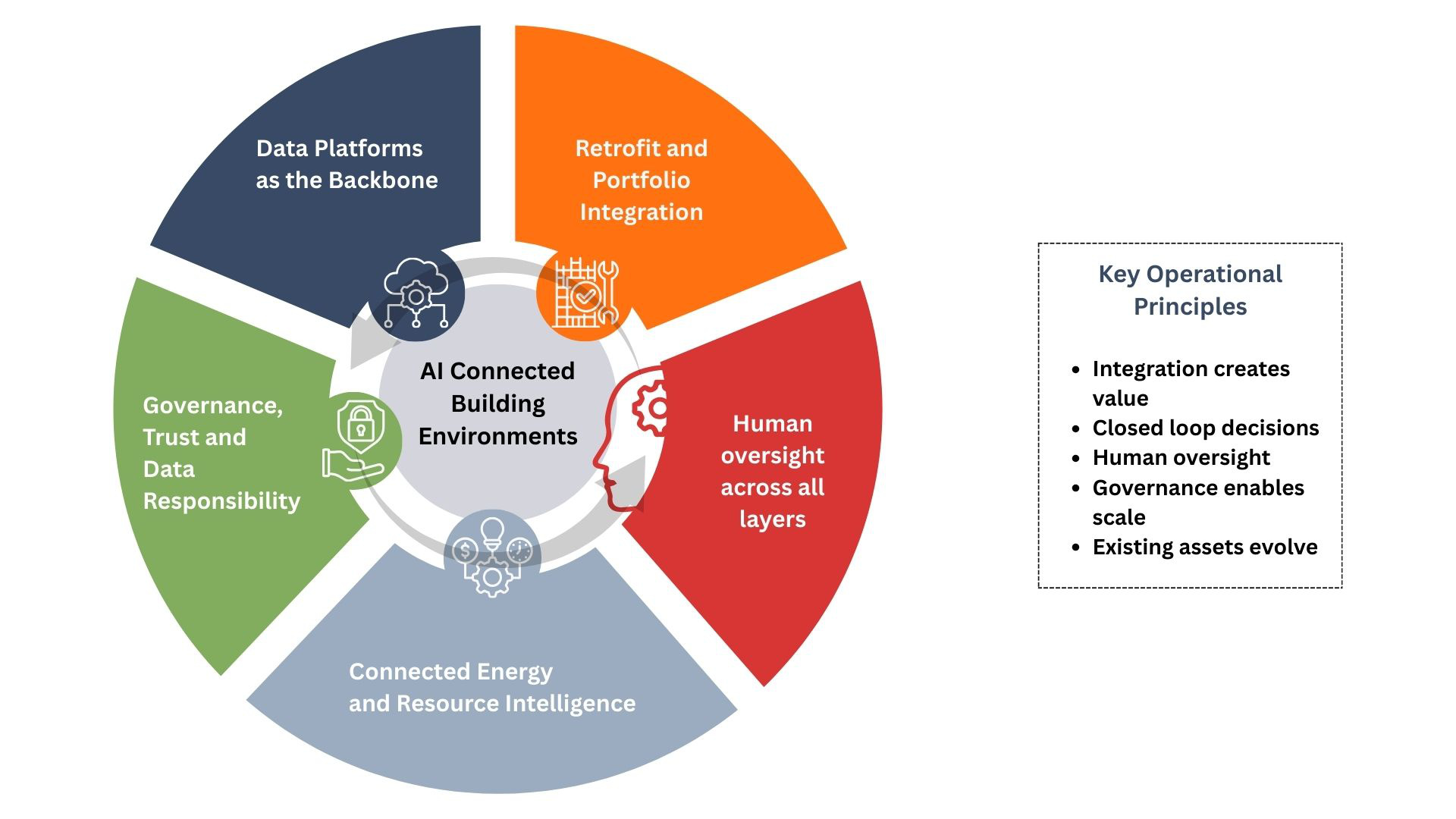
What “AI-Native” Means in Practice
In realized projects, AI-native buildings are defined by continuous feedback loops between sensors, analytics, and operational decisions. Unlike conventional smart buildings, these systems do not rely on static rules but adapt based on real-time data.
The International Energy Agency highlights that AI delivers the greatest operational value when connected directly to control and operational layers, rather than remaining limited to standalone analytics.
In practice, this operational connectivity means that:
- Occupancy data shows how many people are in a building and where they are. This information is used to adjust heating, cooling, and space use throughout the day.
- Energy systems respond dynamically to price signals and grid conditions.
- Digital building systems increasingly enable predictive maintenance and performance insights, reducing reliance on reactive interventions.
This type of operational connectivity is already being deployed across a growing number of buildings and energy systems.
Office Buildings: AI Linked to Occupancy and Energy Use
As artificial intelligence becomes embedded within building systems, the focus shifts from isolated optimization toward continuous operational coordination. In AI-connected buildings, data generated by HVAC, lighting, and occupancy systems extends beyond technical control and begins to actively inform facility management, workplace planning, and day-to-day organizational decisions. The real value of AI in this context lies not in automation itself, but in its capacity to translate building performance into actionable operational intelligence that supports ongoing organizational processes.
One of the most widely documented working examples is The Edge. The building integrates more than 28,000 sensors that continuously monitor occupancy, indoor climate, lighting conditions, and energy performance in real time. These data streams are used to dynamically optimize HVAC operation, lighting levels, and space utilization through advanced analytics and control systems.
Crucially, building intelligence at The Edge is not confined to traditional building management systems. Sensor-based insights are used to support building operations, maintenance planning, and space management, creating a continuous feedback loop between building performance and daily operations.
Rather than serving energy optimization alone, real-time building data supports space management, operational coordination, and corporate real estate decision-making. Independent certification and engineering assessments associate this sensor-driven optimization and continuous commissioning approach with measurable reductions in energy consumption and improved space efficiency, positioning The Edge as a functioning reference for AI-native building operations rather than a conceptual smart building.
Campuses and Mixed-Use Developments: Energy and Operations Connected

At campus and mixed-use scale, AI enables energy systems to operate in direct relation to how buildings are actually used. Rather than optimizing supply in isolation, energy management becomes part of everyday operational decision-making.
A clear working example of this approach is Google Bay View Campus. At Bay View, digitally controlled systems coordinate geothermal heating, on-site photovoltaic generation, and battery storage in real time. Energy systems are designed to respond to building demand and operational conditions, adjusting generation and storage to reduce reliance on fossil-based backup energy.
What distinguishes the campus is the depth of operational integration. Energy decisions are directly linked to building use and facility operations, rather than managed as a separate sustainability layer. This positions Bay View as a practical reference for AI-native campuses where energy performance, building systems, and daily operations are aligned within a single operational framework.
Hospitals: AI Supporting Continuous Operation
Hospitals operate under constant occupancy and strict comfort and reliability requirements, leaving little tolerance for system failure. This makes healthcare facilities a practical testbed for AI-native building systems that prioritize continuity and risk prevention over isolated optimization.
In healthcare settings, AI-supported building analytics are increasingly applied to HVAC performance monitoring, fault detection, and predictive maintenance. Rather than reacting to system failures after they occur, these approaches aim to anticipate equipment inefficiencies and potential disruptions before they impact clinical operations.
Peer-reviewed research published in the National Library of Medicine (PubMed Central) documents how data-driven and AI-supported building management approaches in healthcare facilities are used to support predictive HVAC control, fault detection, and early identification of system inefficiencies. Rather than responding to breakdowns after they occur, these systems enable proactive intervention, helping to maintain stable indoor environmental conditions critical for patient care and clinical operations.
In this context, AI functions as a reliability and decision-support layer within hospital operations. Building intelligence supports continuous healthcare delivery on a day-to-day basis, positioning AI not as an abstract optimization tool but as an integral component of operational continuity in critical care environments.
Data Platforms Connecting Buildings and Operations
As AI adoption scales across building portfolios, data platforms increasingly function as the connective layer between building systems and daily operations. Rather than replacing existing infrastructure, these platforms translate real-time building data into actionable operational control.
One widely cited example is BrainBox AI, which applies machine-learning-based optimization to HVAC systems through real-time data integration. The platform combines weather forecasts, occupancy signals, and building performance data to support dynamic HVAC operation. According to published case studies, this approach is associated with reduced energy consumption while maintaining indoor comfort conditions.
Case studies document measurable energy savings across office, retail, and mixed-use portfolios, demonstrating consistent performance at scale. Crucially, BrainBox AI integrates with existing Building Management Systems, enabling immediate operational impact without requiring full system replacement.
More recently, emerging platform partnerships such as the announced collaboration between BizzTech and Siemens point toward the next evolution of this model, where agentic AI layers and operational digital twins are designed to connect monitoring, decision-making, and action within existing building platforms. In this model, AI functions as an operational intelligence layer that enhances existing assets rather than disrupting them.
Governance and Data Integration Lessons

As AI-connected building systems expand from individual buildings to districts and portfolios, a different set of challenges comes into focus. At this scale, technical capability alone is no longer enough. Operational intelligence only creates value when decision rights, responsibilities, and data use are clearly defined.
A current, large-scale reference is Singapore’s Smart Nation 2.0 program, where digitally enabled building and urban systems are developed within a clearly defined public governance framework. Through coordinated action by the Smart Nation and Digital Government Office and the Building and Construction Authority, data generated by buildings is governed through regulatory disclosure requirements, standardized reporting frameworks, and clearly assigned institutional responsibilities across public agencies and private operators.
In this model, data integration is treated as public infrastructure rather than a proprietary layer. Operational intelligence is enabled through shared standards, regulated access, and transparent decision logic, allowing AI-driven systems to support building operations while maintaining institutional trust and accountability.
This interpretation aligns with broader policy analysis by the OECD, which identifies governance capacity, data stewardship, and accountability frameworks as primary determinants of success in data-intensive urban and building systems. The OECD emphasizes that without clear institutional arrangements, advanced digital infrastructure struggles to achieve trust, legitimacy, and operational continuity.
These lessons underline that AI-native buildings and districts require more than connected systems. They depend on robust data governance structures, transparent operational logic, and clearly defined roles between public authorities, operators, and users. Without this alignment, even technically advanced systems struggle to translate intelligence into trusted, long-term operational value.
Human-in-the-Loop Operations
Across realized AI-connected building projects, artificial intelligence is not replacing human decision-making. Instead, it is changing where human expertise sits within daily operations. Facility managers increasingly move away from manual system control toward supervision, interpretation, and strategic adjustment, using AI-generated insights to guide decisions rather than executing fixed automation scripts.
This operational shift has been identified by the Boston Consulting Group as a critical success factor for deploying AI in physical and operational systems. BCG’s 2025 analysis shows that AI delivers sustained value only when human expertise remains embedded in oversight, exception handling, and performance calibration, particularly in environments where systems operate continuously and conditions change dynamically.
In practice, this means that user feedback, manual overrides, and comfort responses are not treated as system failures but as inputs into the learning process. Human intervention becomes part of how AI systems adapt over time, helping them remain responsive to real operational conditions rather than enforcing rigid, pre-defined rules.
In AI-native buildings, the human-in-the-loop model supports long-term reliability and trust. By keeping accountability and judgment with people, while delegating pattern recognition and optimization to machines, operational intelligence remains both effective and context-aware.
Why These Use Cases Matter
Taken together, these projects reveal a consistent pattern. AI creates value in the built environment when it is directly connected to daily operations. Gains in energy efficiency, comfort, resilience, and cost control emerge not from isolated innovation, but from integrated intelligence that links building systems with operational decision-making.
This shift reflects a broader transition identified by the World Economic Forum, which frames buildings and infrastructure as operational platforms rather than static assets. In this context, digital and AI systems deliver impact when they support continuous coordination between physical performance, human oversight, and organizational processes.
As buildings increasingly function as active operational systems, AI-native connectivity becomes a baseline requirement rather than an experimental feature. The relevance of these use cases lies not in technological novelty, but in their ability to demonstrate how intelligence translates into everyday operational value.
Management Summary
Listen now: your management summary in audio format.