
Reading time: 4 minutes
Key Learnings
- HVAC optimization software typically reduces energy use for heating and cooling by 10% to 30%. Payback is around two years.
- 40% to 50% of commercial buildings have no digital HVAC management at all. Only 2% to 5% use automated control.
- The main barriers to adoption are organizational: incentives are misaligned, identified issues are not acted on, and savings are difficult to verify.
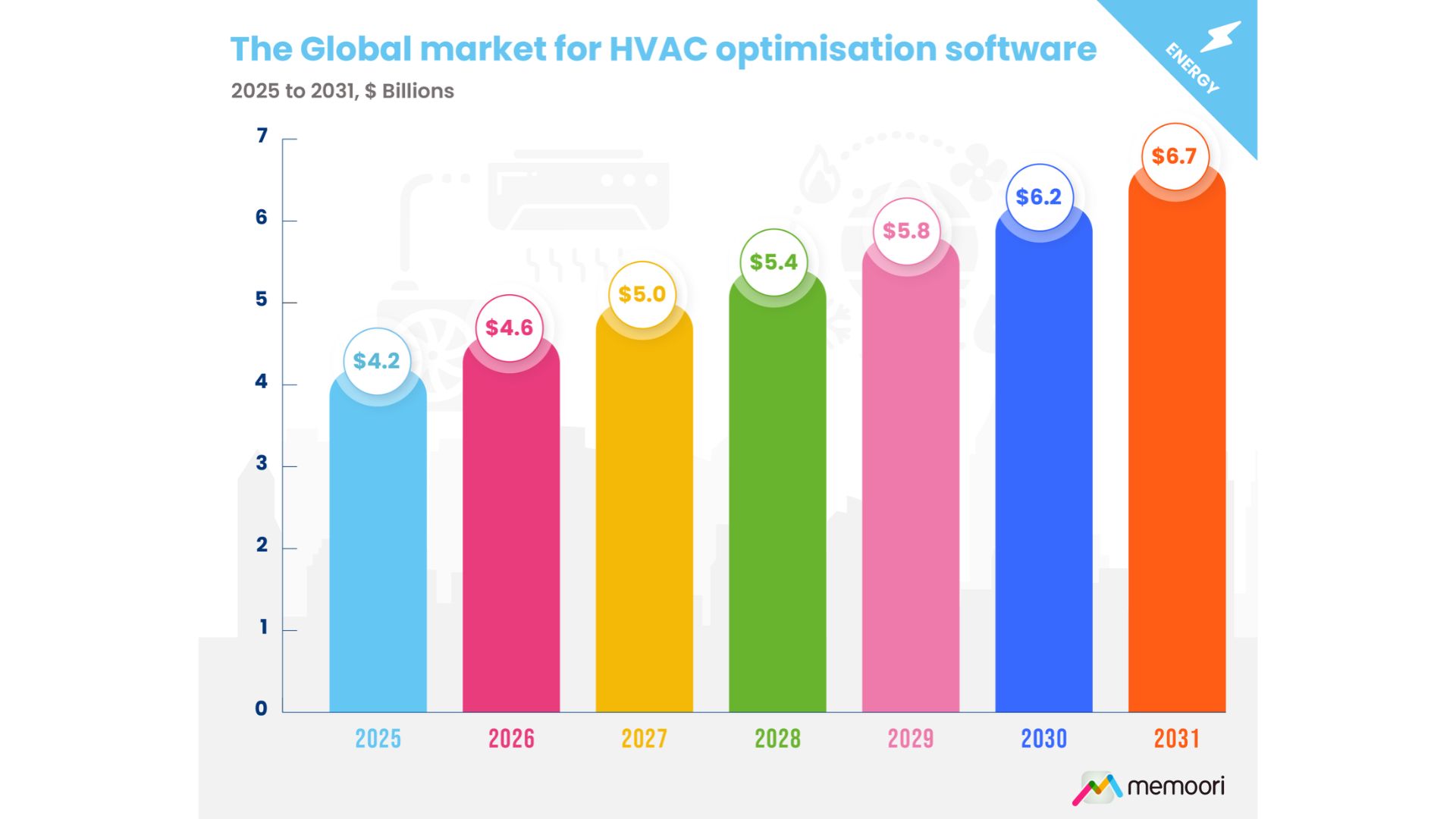
- The global market is expected to grow from $4.6 billion in 2026 at an annual rate of 8.1% to $6.7 billion by 2031.
- Major HVAC manufacturers are acquiring specialized software providers. The companies most likely to grow are those that deliver not only the algorithms, but also the implementation.
Heating, ventilation and air conditioning are among the largest energy consumers in office buildings, retail and data centers. The technology to cut this consumption significantly has long been available, yet it is rarely used: there is a wide gap between what the software could deliver and what actually runs in buildings. That gap is the story of Memoori’s new report, Energy Management Software for HVAC Optimization in Commercial Buildings 2026 to 2031.
What HVAC Optimization Delivers
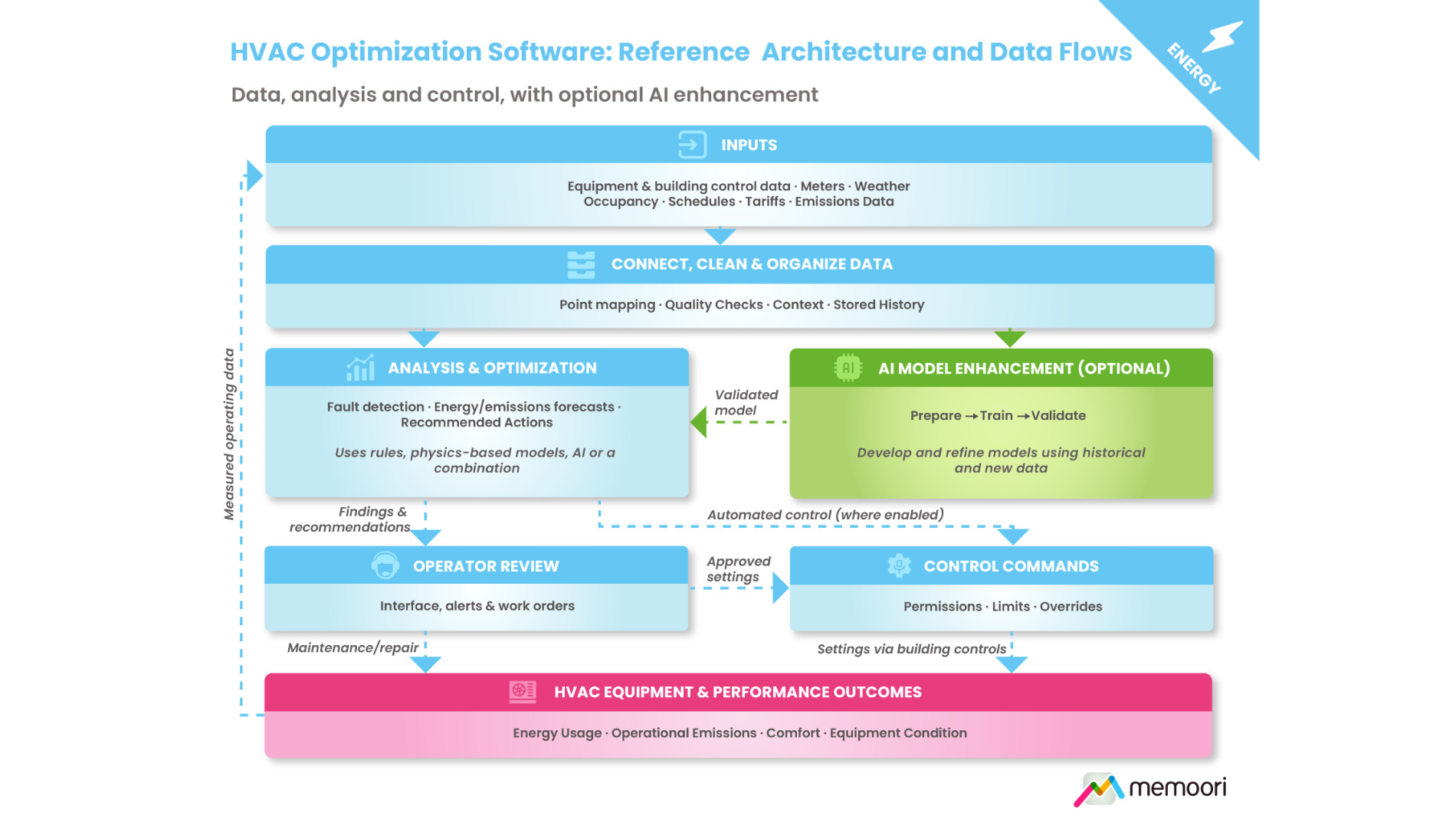
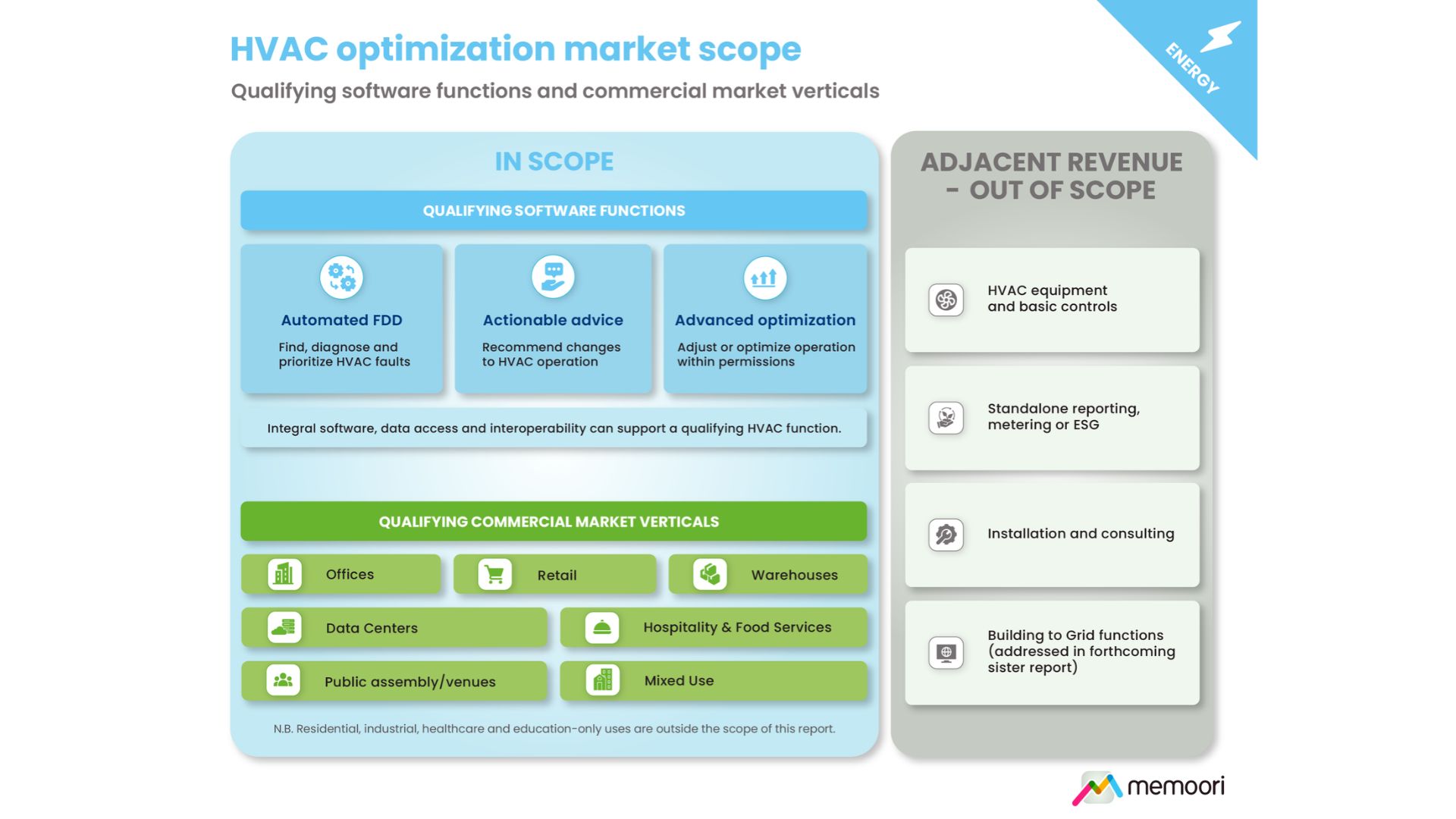
The report places three functions at the core of the market. Automated fault detection and diagnostics (FDD) finds, diagnoses and prioritizes faults. Building on this, actionable advice recommends specific changes to HVAC operation. Advanced optimization goes furthest: the software adjusts operation itself, within defined permissions.
The software draws on data from equipment and building controls, meters, weather, occupancy, schedules, tariffs and emissions factors. This data is cleaned and organized, then analyzed using rules, physics-based models, AI or a combination of these. Depending on what is enabled, the results go to operators for review or directly to the building controls as control commands.
The report covers offices, retail, warehouses, data centers, hospitality and food services, public assembly venues and mixed-use buildings. It excludes HVAC equipment and basic controls, standalone reporting, metering and ESG tools, installation and consulting services, and building-to-grid functions, which Memoori addresses in a separate report.
HVAC Optimization Savings
Independent studies support savings of 10% to 30% of HVAC energy. The US Department of Energy puts the average from high-performance control sequences at about 30%. A 2026 Berkeley Lab field study of 17 projects found a median of 18%, in a range from -2% to 49%.
A 2022 study of analytics and fault detection deployments across 24 organizations found a median simple payback of two years, including internal labor and repair costs. But staff time costs more than the software license. The software finds the problem; people fix it. Budget for the license alone, and you have bought an expensive alarm system.
Most Buildings have Barely Started
We estimate that 40% to 50% of commercial buildings have no digital HVAC management at all, and another 35% to 45% have only basic schedules, setpoints, and alarms. Just 10% to 15% use software to diagnose faults and recommend fixes. Fully automated control sits at 2% to 5%.
The biggest near-term opportunity for HVAC Optimization software is not advanced autonomy. It is moving the bottom tiers up to diagnostics.
The Barriers are Organizational, not Technical
- The approver is not the saver. In leased space, the owner pays and the tenant often gets the lower bill.
- Findings are not fixes. Every fault alert needs someone to investigate, fund and repair it.
- Savings are hard to prove. The baseline moves with weather, occupancy and tenants.
- Data and integration. Facility managers rank these as the biggest barrier to scaling artificial intelligence (AI), ahead of budget.
The owners making progress have changed the deal, not the algorithm. Vornado Realty Trust wrote cost recovery for efficiency upgrades into 88% of the leases it signed in 2025. The Meridian Group budgets Clockworks Analytics fault detection into the underwriting of every building it buys. Essential Properties Realty Trust works with Budderfly, which funds upgrades at no cost to tenants.
A $4.6 Bn Market with a Missing Middle
We estimate global revenue from HVAC optimization software in commercial buildings at $4.6 billion in 2026, growing 8.1% a year to $6.7 billion by 2031.
We identified 126 vendors. Some 73% have 250 or fewer staff, 21 belong to groups with more than 10,000, and only 13 sit in between. Specialists have the software but lack delivery scale; the giants have the channel but need the software.
Hence the HVAC Optimization deals: Trane bought BrainBox AI, Johnson Controls bought Nantum AI, Copeland agreed to buy Bueno Analytics, and Carrier bought 75F just 17 months after taking a minority stake.
Delivery Beats Algorithms
The algorithm is becoming table stakes. Vendors that bundle integration, commissioning, verification, and someone to act on the findings will take a disproportionate share of the growth. Venture money is chasing autonomy, but the nearer-term revenue is in getting basic buildings onto diagnostics.
But if AI automates data cleaning and commissioning, the delivery bottleneck shrinks, and growth could beat our forecast.
Five Questions Owners can ask any HVAC Optimization Vendor
- Savings of what: HVAC energy, the central plant, or the whole building?
- What is the baseline, and who verifies the savings?
- When the software finds a fault, who fixes it, and who pays?
- What can it actually change, and how do we override it?
- What is the total cost over the contract, including our staff time?
The full 290-page research report includes forecasts to 2031 by region and building type, a 126-company listing, 10 company profiles, and an Excel datasheet.