
Reading time: 3 minutes
Key Learnings
- Smart building startups are attracting significantly more capital again: more than USD 5.6 billion flowed into 169 funding rounds in the first half of 2026.
- Investment volume increased by 80 percent year over year, while the number of deals rose by 34 percent.
- The market appears more mature than in earlier boom phases, with capital concentrating on AI-powered platforms, solid business models, and clear market positioning.
- Major smart building players such as Siemens, ABB, Schneider Electric, Carrier, and Honeywell are increasingly investing directly or joining strategic funding rounds.
- Acquisitions are gaining momentum: 46 deals in the first half of 2026 show that consolidation is increasingly shaping the smart building technology market.
Venture capital is flowing back into smart buildings – and faster than at any point since the boom years. New research from Memoori shows investors committed more than $5.6 billion to startups serving the commercial buildings sector in the first half of 2026 alone, an 80% jump in value year on year. Behind the headline number lies a market that has matured: capital is concentrating on AI-driven platforms with proven business models, industry giants like Siemens, ABB and Schneider Electric are increasingly investing directly, and acquisitions are reshaping the competitive landscape. A look at where the money is going – and what it signals for the future of building technology.
In the first half of 2026, Memoori Research tracked 169 funding rounds worth more than $5.6 billion flowing into young companies serving the commercial buildings sector. That represents an 80% jump in value compared with the same period last year, and 34% more deals. After three years of cautious capital, the investment is returning.
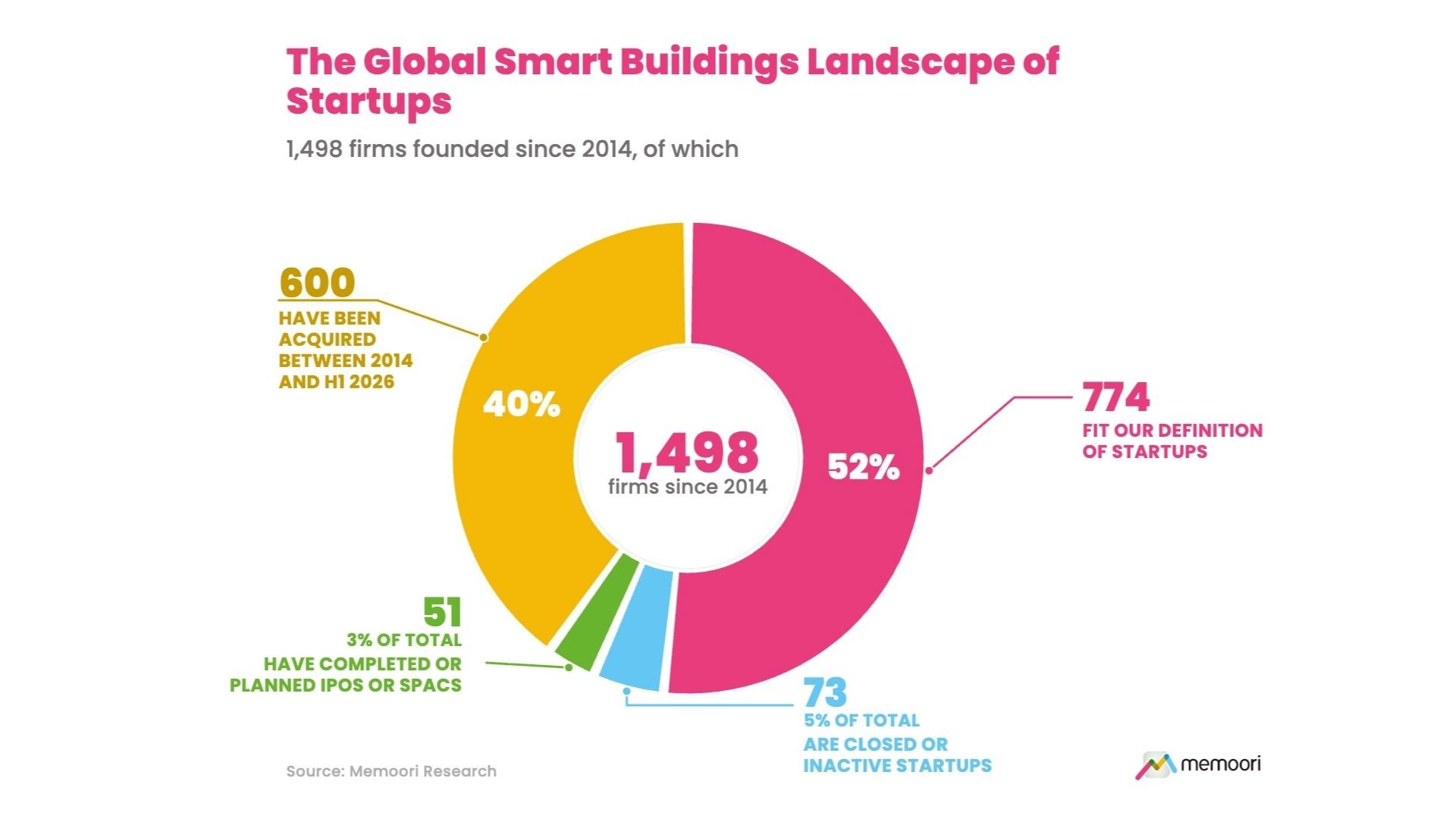
Memoori’s startup market landscape maps 1,498 technology startups founded since 2014, of which 600 have been acquired, and 51 have completed or planned IPOs.
From Slowdown to Surge
To appreciate the scale of this rebound, it helps to look back. Following the record-breaking years of 2021 and 2022, funding for smart building startups cooled to $5.2 billion across the whole of 2023. The market recovered some ground in 2024 and 2025. But H1 2026 alone has nearly matched 2023’s full-year total, putting the market firmly on course for a big investment year.
This is not a bubble inflating indiscriminately. Over the past decade, more than $61 billion has flowed into smart building startups, and the pattern of investment in 2026 looks markedly different from the exuberance of five years ago. Capital is consolidating around proven winners, companies with AI-powered solutions, strong fundamentals, and clear market positioning. Investors have learned which business models survive contact with the realities of commercial real estate, and they are backing them at scale.
Where is the Money Going?
Artificial intelligence sits at the center of nearly every major smart building startups deal. The largest funding round of the half went to Cloover, a German startup whose AI-powered platform supports renewable energy installers, which raised an extraordinary $1.2 billion Series A in January. Energy and infrastructure themes dominated the top of the table, from Sigenergy’s distributed energy storage to Armada’s modular data centers, backed by Johnson Controls.
That last detail points to a second defining trend: the industry’s biggest names are no longer watching from the sidelines. In H1 2026, 23% of strategic investments in startups involved a major smart buildings player. companies like ABB, Carrier, Honeywell, Schneider Electric, and Siemens, acting either as sole investor or as part of a round. The incumbents have decided that the fastest way to acquire new digital capabilities is to fund, partner with, or simply buy the startups building them.
Consolidation Gathers Pace
Memoori recorded 46 acquisitions of smart building startups in the first half of 2026, ahead of the same period last year and confirming strategic acquisition as the primary exit path for founders in this market. The standout transaction was Autodesk’s $3.6 billion purchase of MaintainX, an AI-powered maintenance and asset management platform founded only in 2018, a deal valued at roughly 18 times projected revenue, and a clear signal of what acquirers will pay for AI-native software with real traction.
Taken together, the funding surge, incumbent participation, and intense M&A activity describe a market reaching a new stage of maturity. The question for investors, corporates, and founders alike is no longer whether digital technology will reshape how commercial buildings are designed and operated, but who will own the platforms that do it.
The Full Smart Building Startups Picture
These headlines only scratch the surface. Memoori’s new report, Smart Building Startups H1 2026, provides the complete analysis: every funding round and acquisition tracked over the past six months, and a decade of investment data for context.