
Reading time: 8 minutes
In listed buildings, innovative technologies such as smart control systems, networked security facilities and energy-efficient solutions must be integrated in such a way that the character and integrity of the architecture are preserved.
Challenges and Solution Approaches
The technical modernisation of listed buildings requires more than just structural sensitivity. It demands strategic planning and an interdisciplinary approach along the following key aspects:
- Structural restrictions vs. technical integration
A major challenge lies in the fact that conservation regulations often prohibit visible cables, pipes or devices which would alter the historic fabric of the building.
To meet these requirements, preference is given to wireless or battery-operated components, as seen with modern access systems. These solutions function without complex cable installation, thus minimising structural interventions and making subsequent dismantling easier. In addition, sensors and actuators are specifically placed in architecturally compatible positions, often hidden behind claddings or integrated into existing building elements, so that the historical appearance is not compromised.
- Interoperability and system openness
Another challenge arises from the fact that the various technical trades such as security, climate, energy and access often use their own protocols and isolated solutions. To solve this problem, open standards such as BACnet or KNX are used in building automation. They enable seamless communication between the systems and allow central operation even with complex installations. It is also sensible to integrate all technical and security-relevant data into a central management system, providing a consolidated overview and control.
- User flexibility and dynamic operational processes
The wide range of different user groups with changing access and security requirements presents a particular challenge for building technology, as it necessitates flexible solutions. Web-based management platforms make it possible to control and customise access rights according to time and area. In addition, operating parameters can be automatically adjusted through the use of user profiles and predefined scenarios, making operation dynamic and efficient.
- Operational reliability and maintenance
The long-term maintenance of technical systems, especially in listed buildings, is associated with high costs and significant effort. To ensure sustainable operational reliability, it is advisable to conclude maintenance contracts with manufacturers or providers who also guarantee long-term support and regular updates. In addition, modular and easily replaceable components are often used in order to keep downtimes and interventions in the building fabric to a minimum.
- Data protection and access control
A major challenge lies in the fact that conservation regulations often prohibit visible cables, pipes or devices which would alter the historic fabric of the building. To meet these requirements, preference is given to wireless or battery-operated components, as seen with modern access systems. These solutions function without complex cable installation, thus minimising structural interventions and making subsequent dismantling easier. In addition, sensors and actuators are specifically placed in architecturally compatible positions, often hidden behind claddings or integrated into existing building elements, so that the historical appearance is not compromised.
Monument Protection Meets Flexible Building Technology: Frauenkirche in Dresden
The Frauenkirche in Dresden, with its distinctive dome, is one of the most significant Baroque buildings. With an average of two million visitors per year, it is an important architectural, spiritual, and cultural attraction and a landmark of the city of Dresden. However, it is not only visitors who enter the church, but also craftsmen, sextons, cleaning staff, the choir, organists, pastors, and voluntary pastoral workers.
Therefore, as part of regular maintenance measures in 2023 and 2024, a new electronic locking solution from Assa Abloy was to be installed that meets the requirements of the various user groups and offers the best possible balance between security and flexibility. Another important aspect was to keep the effort for installation as low as possible in order to preserve the historic character of the Frauenkirche. This heavily frequented sacred building demonstrates that electronic locking systems can play a central role in secure and flexible building use. Different user groups with varying access requirements necessitate differentiated, time- and area-based access control.
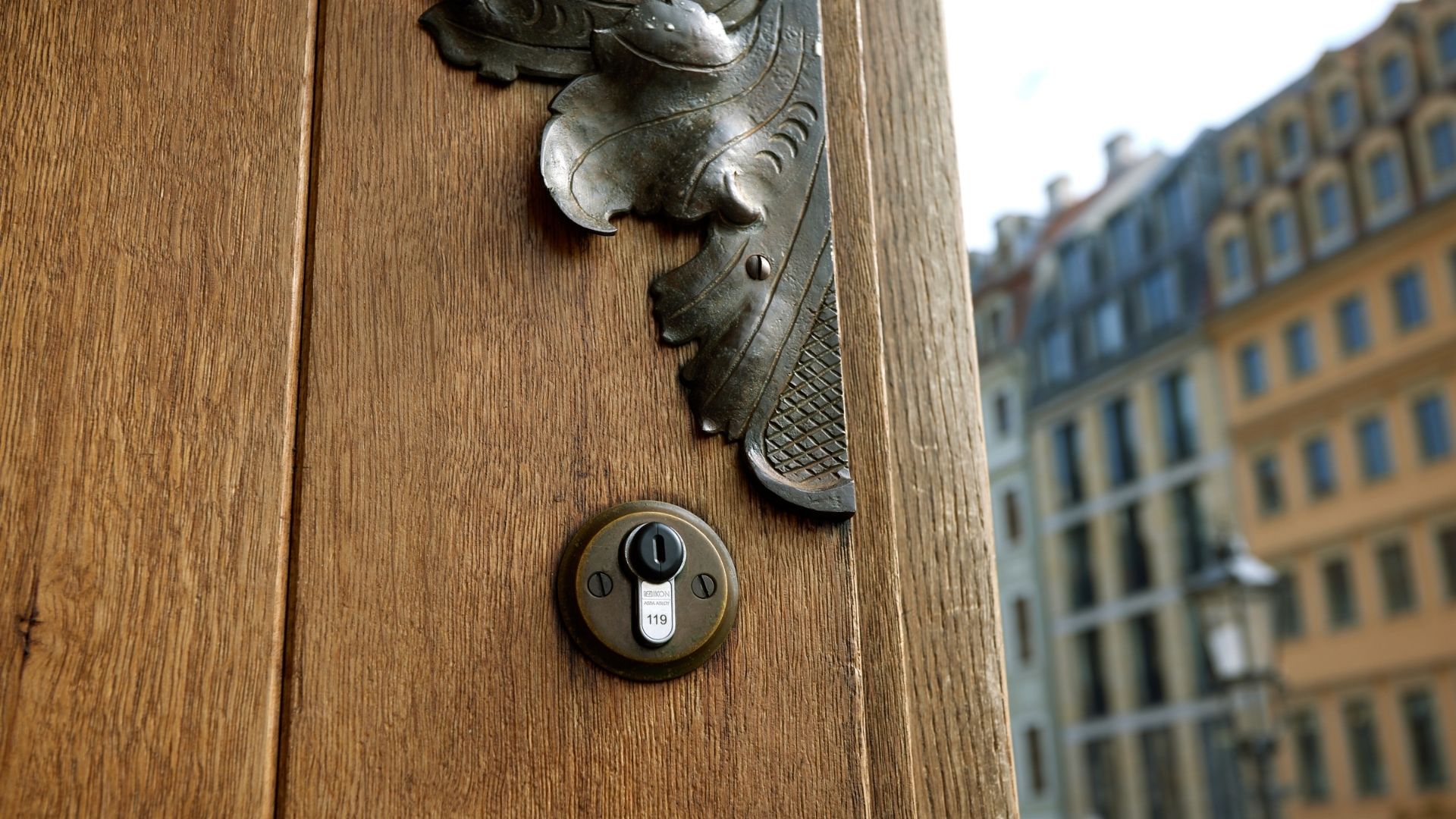
Electronic locking cylinders without visible operating elements can be discreetly integrated into existing door setups, thus meeting both technical and conservation requirements. The management of locking authorisations is software-based and allows for rapid adjustments in the event of organisational changes. Lost keys can be specifically deactivated without having to replace mechanical components or restrict operations.
A key advantage of such systems lies in their installation simplicity. The replacement of mechanical cylinders with electronic variants is possible without additional cabling, as the power supply is provided by batteries in the key itself. Consequently, structural intervention is reduced to a minimum, which is particularly decisive for historic structures. Overall, corresponding projects show that integrated electronic building technology can be implemented economically, reliably, and with minimal impact on the substance, even in listed buildings.
Digital Building Technology for Sustainable Monument Conservation: Löfstad Castle
An example from the international context shows how digital twins and IoT sensor technology can contribute to recording indoor climate and temperature trends. At Löfstad Castle in Sweden, a parameterised digital twin was deployed to collect extensive sensor data and derive strategies for ventilation and preservation of the historic building fabric — an approach that opens up future potential for similar projects.
The focus is on the development of a parametric digital twin, realised through the use of IoT sensors, cloud and edge computing, and semantic data models. In the project described, numerous sensors were installed throughout the building for continuous monitoring of temperature, humidity, and other climate-relevant parameters. The data thus obtained enables detailed analysis of the indoor climate and forms the basis for well-founded decisions in heating, ventilation, and moisture protection.
The results show that moisture problems in the lower areas of the building, in particular, pose a central risk to the building fabric and historical materials. At the same time, it becomes clear that existing natural ventilation concepts are insufficient to ensure adequate indoor quality during intensive use. Through an integrated consideration of building physics, usage, and technical building equipment, targeted measures such as vapor barriers or energy-efficient heating strategies can be developed that take into account both monument protection and sustainability objectives.
This example demonstrates that digitisation and monitoring projects are transferable beyond individual cases. Modular, scalable, and cost-efficient solutions with open technologies offer great potential for other listed buildings. Thus, integrated building technology makes an important contribution to data-based, sustainable, and substance-preserving monument conservation.
Learn more about the changing use of religious buildings and the secularization of sacred spaces.
Access Control for Historic Buildings: Hamilton House, Dublin
Historic buildings are valuable cultural assets with stories hidden within their walls. The challenge lies in harmoniously integrating modern security and access systems into these architectural gems.
An outstanding example of dealing with cultural heritage can be found in the centre of Dublin, Hamilton House – one of the city’s most famous architectural monuments. The house is located at the intersection of Leeson Street and Fitzwilliam Place and was built in 1854 in the Victorian Gothic style. Careful restoration has preserved its splendor while simultaneously creating a modern office standard. Elegance has always been a priority, and Hamilton House has been regarded as a symbol of exceptional quality for over 160 years.
Securing such a listed building is a special task. Traditional systems require elaborate cable installations and invasive interventions, such as laying cables or drilling through old doors. These methods can endanger the character and lead to damage. For this reason, a modern security concept was developed in Dublin that is both discreet and reliable. It was to provide comprehensive protection and meet all compliance requirements without disturbing the appearance. Authenticity and compliance with emergency exit regulations such as EN179 were imperative. The use of wireless technology meant that no elaborate or invasive installation measures were necessary, so original walls, doors, and surfaces remain untouched. Modern wireless locks are designed for both security and compliance with legal requirements. In Dublin, every door locks automatically after closing, always ensuring a safe environment. These systems meet the EN179 standard for emergency exits and thus guarantee a safe and regulation-compliant escape route in the event of an emergency. Wireless access systems also offer unrivalled flexibility, enabling users to effortlessly switch between digital key options on their smartphone and traditional key cards or transponders.