Reading time: 8 minutes
Buildings must also become more resilient to increasingly extreme weather conditions.
What can adaptive façades achieve in this context? We discussed this with Christina Eisenbarth, professor and head of the ITRA Institute for Technology and Resilience in Architecture at the Technical University of Darmstadt, and Silas Kalmbach, research assistant at the University of Stuttgart's Institute for Lightweight Structures and Conceptual Design. The two worked together when they began their research activities.
Everyone is talking about climate change. Which means adaptive façades must be an exciting field of research, doesn't it?
Christina Eisenbarth (CE): Of course! Façades are the largest exposed surfaces in densely built-up inner-city areas and have a major impact on our climate. Indeed, being the outer shell of a building, they significantly influence both the indoor and outdoor climate. This is because, when exposed to sunlight, façade materials can heat up to around 50 K above the ambient air temperature and release this heat into the surrounding environment. This accumulated radiant heat intensifies the urban heat-island effect, leading to an average temperature increase of up to around 12 K compared to nearby rural areas. In this case, air conditioning systems are not a solution because they release their waste heat into the urban atmosphere, thereby exacerbating the very problem they are supposed to solve.
There is also talk of resilient architecture in relation to extreme weather events or environmental disasters. What does this mean for façades?
CE: For us, resilience means minimising the causes of climate change preventively (climate protection / mitigation) at the same time as maximising the adaptability of our buildings and neighbourhoods to the unavoidable consequences of climate change, such as heat and heavy rainfall (climate impact adaptation). Adaptive façades have properties that can make our built-up environment more resilient to a variety of climatic influences, for example, a dynamic sun-protection system that controls the light transmission and reflection properties of the façade so the amount of solar heat entering the building is reduced in summer, while passive solar energy gains are achieved in winter. Adaptive systems like this not only help protect the climate by reducing the energy required to cool or heat buildings but also help us adapt to climate change by responding to changing weather conditions. Concepts such as HydroSKIN take climate change adaptation one step further.
You developed HydroSKIN and have already received several national and international awards for it. What distinguishes the HydroSKIN concept?
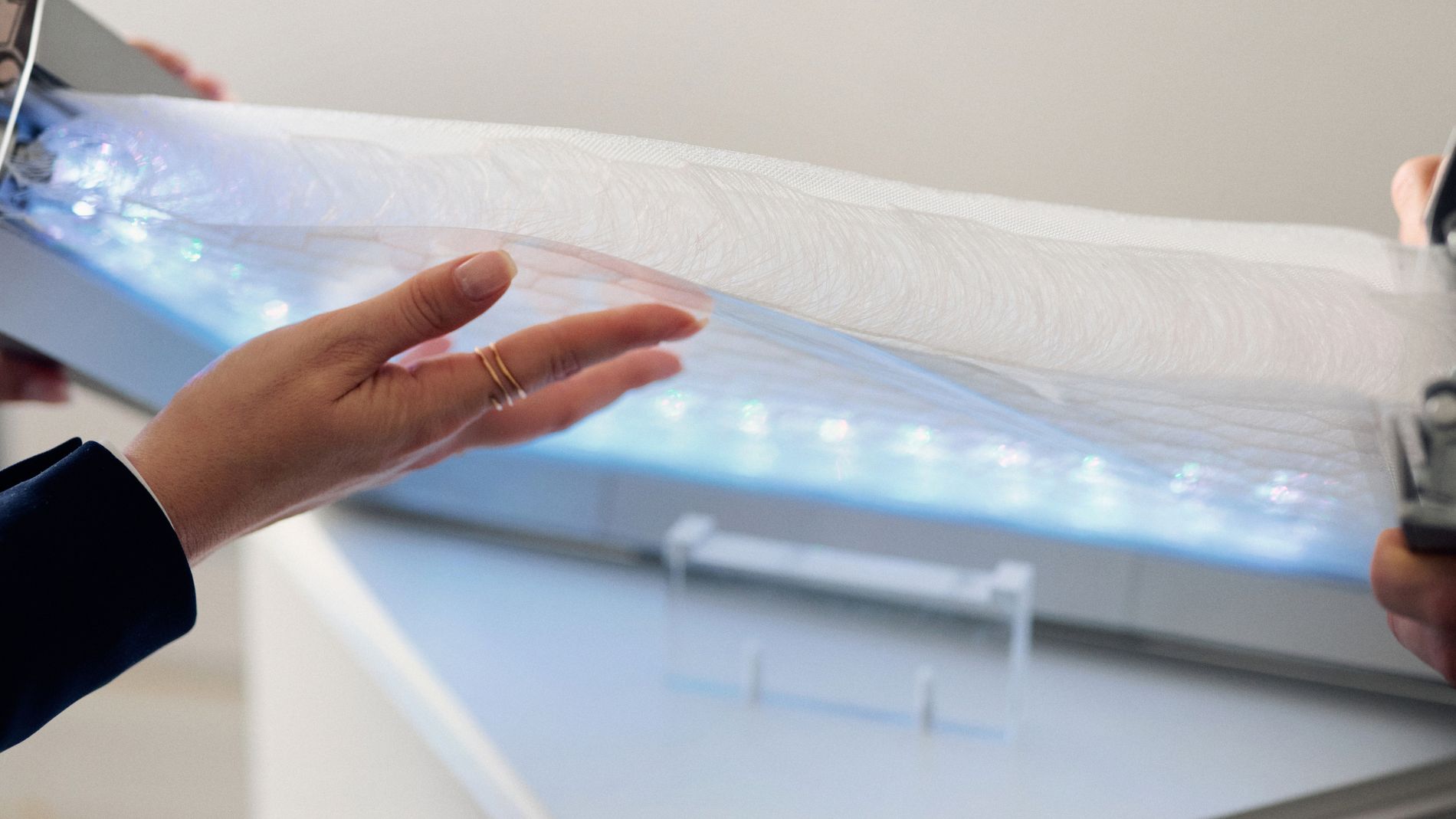
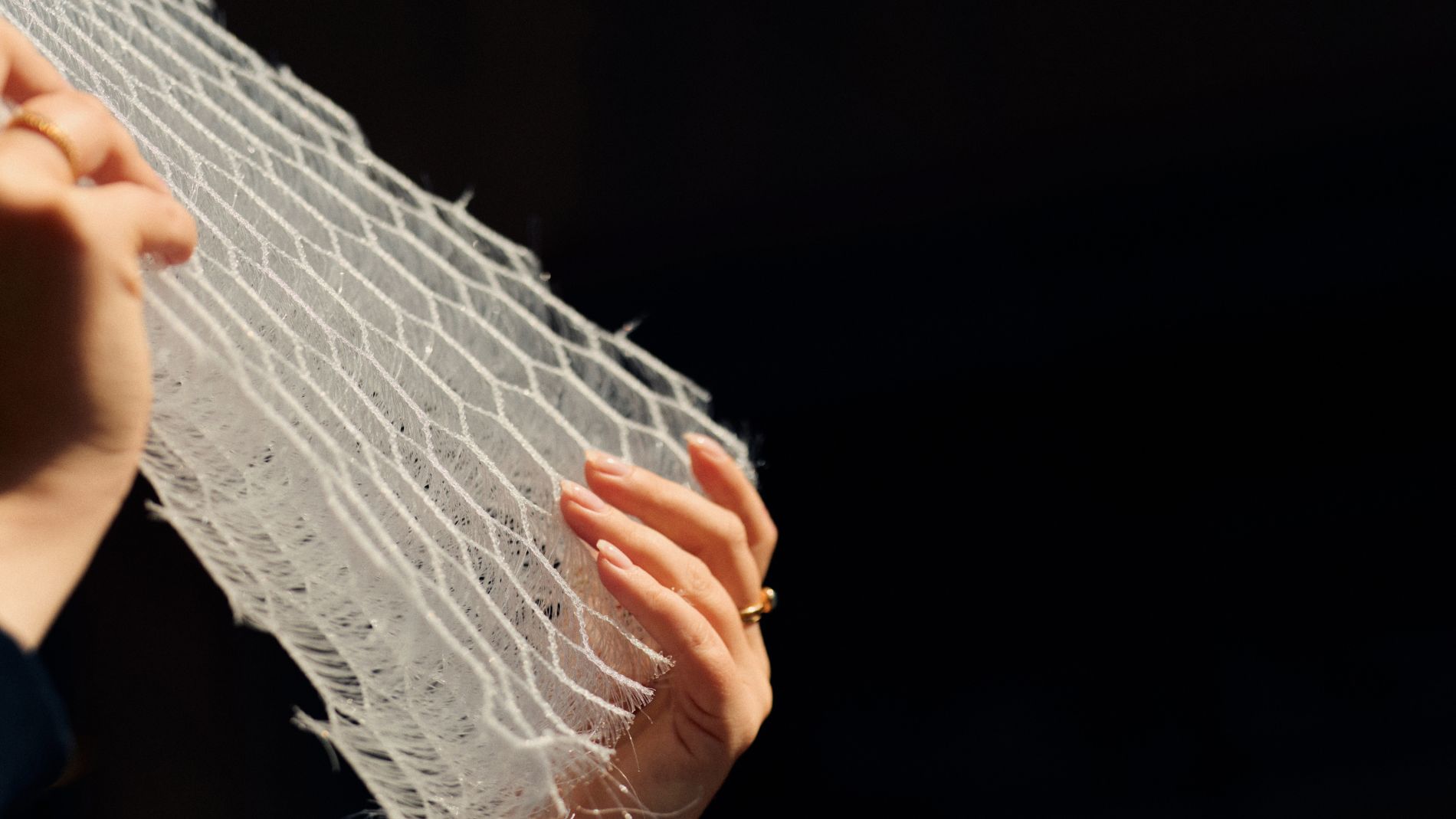
CE: HydroSKIN is a kind of ‘functional clothing’ for the façade that absorbs rainwater and cools it through evaporation. The façade elements consist of a multi-layered textile and membrane structure stretched across an aluminium frame. The outer layer is water-permeable and also acts as a filter, preventing insects and dirt particles from entering the system. Behind it, a three-dimensional spacer fabric directs the raindrops to a water-bearing membrane, via which they flow into a channel in the lower frame profile. From there, the rainwater collected can be piped into a reservoir or used in the building as service water, for example for toilet flushing, washing-machine operation or plant irrigation. During heat waves, suitably treated water is fed back into the spacer fabric via spray nozzles in the upper frame profile, the large, air-flowed surface of which permits effective evaporation, cooling both the urban environment and, indirectly, the interior of the building. In this way, excess rainwater becomes a dual-purpose resource. We have been testing HydroSKIN prototypes under real weather conditions at the D1244 high-rise building at the University of Stuttgart since 2022.
What distinguishes adaptive façades from conventional building shells?
CE: In essence, traditional façades are static systems – they always perform the same function, regardless of changes in the climatic conditions or user requirements. Adaptive façades, on the other hand, respond to external and internal influences such as sunlight, temperature, rain, wind or even the behaviour and needs of the building users. We distinguish between passive-adaptive and active-adaptive systems. Passive-adaptive systems work purely on the basis of the intrinsic properties of the materials with no external energy input. Examples include thermochromic glass, which darkens automatically when heated, and hygroscopic wood, which warps when exposed to moisture. Active-adaptive systems, by contrast, have sensors, actuators and a control unit that enable the façade to respond in a targeted and systemically controlled manner. Such systems can be controlled precisely and predictively by taking account of weather and user forecasts.
How would you characterise HydroSKIN? Is the concept passive or active-adaptive?
CE: HydroSKIN has a little bit of both. In principle, rainwater absorption works passively: the textile surface is so finely structured that it slows down and splits the raindrops that hit it, allowing it to absorb them instead of reflecting them so they bounce off. This reaction is intrinsic to the material, i.e., there is no need for sensors or energy input. Evaporative cooling, on the other hand, is actively controlled. To this end, a simple control system can be used that responds either to sensor data or to weather forecasts. As soon as certain threshold values are reached or predicted, a valve is opened and water is fed back into the textile element where it evaporates to generate the desired cooling effect. In this connection, the valve acts as an actuator controlled by relevant parameters. Alternatively, this process can also be triggered manually, without an automated control unit, in other words, by a switch.
HydroSKIN is based on the sponge-city concept. How can climate protection and climate change adaptation be combined in a concept of this kind?
CE: In our research, we aim to minimise the ecological footprint of our built-up environment by cutting down on resources, energy and emissions at the same time as maximising the adaptability of architecture to climatic change and increasingly extreme weather events. HydroSKIN is a good example of this. The system requires hardly any additional materials, can be made from recycled raw materials, such as PET bottle waste, and can be completely taken apart and returned to the material cycle at the end of its useful life. By collecting rainwater, buildings can save up to 46 percent of fresh water. At the same time, HydroSKIN reduces the energy required for building cooling and water treatment by as much as 23 percent, thereby reducing the associated emissions, too. During heavy rainfall, the façade reduces the load on overwhelmed sewer systems and helps minimise urban heat islands. Our measurements showed that, on a hot summer's day, one square metre of HydroSKIN can compensate for the rise in temperature of approximately 1.4 m² of asphalt, 1.6 m² of concrete or 1.8 m² of dark metal façade.
Herr Kalmbach, you focus on energy efficiency and user comfort. What can adaptive façades achieve in this connection?
Silas Kalmbach (SK): They can, for example, regulate the incidence of light and shading, as well as harness solar gains in winter and prevent overheating in summer. It is also possible to influence the heat and cooling balance through integrated surface heating systems, for example. Additionally, there are adaptive materials and systems that enable changes in acoustics or the U-value to be made, and we have already conducted research into various systems of this type at ILEK. When it comes to ventilation, adaptive façades can regulate natural air flows while continuously monitoring air quality and CO₂ levels, which reduces energy consumption at the same time as improving user comfort.
What potential do adaptive façades have for net-zero buildings?
SK: According to our simulations, adaptive facades, such as switchable glazing, can achieve energy savings of 10 to 40 percent compared to static façades, which represents a significant contribution to the reduction of energy consumption. Nevertheless, the building itself must become an energy producer for the energy balance to reach net zero. The simplest and most cost-effective way of achieving this at present is to integrate photovoltaics and solar thermal energy into the façade for the generation of electricity or heat. Organic photovoltaics, i.e., transparent polymer-based solar cells that generate electricity while allowing light to pass through, also already exist.
How do adaptive façades work from a technical perspective?
SK: They work on the control-loop principle. Adaptive façades detect the prevailing conditions and respond to any changes by making appropriate adjustments. This requires sensors, actuators and a building management system (BMS). The sensors record a variety of parameters, such as temperature, brightness, wind and air quality, and the resulting data is evaluated by a control unit or AI, which then decides what action to take, such as adjusting slats, opening windows or varying the transparency of a glass surface. Subsequently, the necessary actions are carried out by actuators, for example, by moving elements of the façade, such as slats or blinds, switchable glazing or ventilation flaps. The interaction between the façade, building-services technology and users is crucial.
Does this mean that AI already plays a key role in façade control?
SK: AI-aided systems, including those for façade control, are now a reality. AI not only analyses sensor data in real time, but also takes account of weather forecasts, electricity tariffs, occupancy data and even individual user habits. These are specialist systems that have been trained to perform very specific tasks or sequences of actions – they are individual solutions for individual buildings. The challenge arises when universal AI models standardise the control of façades with a holistic solution, as ChatGPT did for text processing.
Which brings us to the subject of your doctoral thesis...
SK: Exactly. There is no comprehensive AI that everyone uses in the field of façade control. Or, to put it another way: there is no ChatGPT for façades. In my work, I use the example of switchable glazing, electrochromic and liquid crystal-based glazing to find a general approach that should work for most façades without having to develop a separate model to control each individual façade. The aim is to create a self-training algorithm that is independent of any building and uses machine learning to decide for itself what must be done to control and regulate a specific façade. This means a single AI calculates the optimal conditions for each building individually and there is no longer any need for complicated building simulations or algorithm development for each individual façade. That is the added value of my work.
Where is research heading? Is the focus more on the materials or the algorithms?
CE: One increasingly important field of research is, in my opinion, functional integration, i.e., how to integrate technical functions into buildings and components in a meaningful way and, at the same time, how to exploit synergies between different façade and building technologies. Evaporative cooling systems such as HydroSKIN can, for example, be combined with switchable insulation so the cooling effect can be channelled even more precisely into the interior. Combining such systems with building-integrated photovoltaics also unlocks new potential: evaporative cooling lowers the operating temperature of the modules, thereby increasing their efficiency. Similar synergies are possible with green façade systems.
SK: Algorithms are self-learning AI systems with predictive control, which not only respond to predefined scenarios but also anticipate and respond proactively. Key areas of research, including my own personal focus, revolve around control strategies based on machine learning and multi-objective optimisation, for example, to improve energy efficiency, daylighting and comfort. The biggest challenge is in system integration, that is to say: interfaces between the façade, heating, ventilation and air conditioning, energy management and building automation must be interoperable, standardised and secure. Without unambiguous protocols and uniform platforms, projects are likely to fail because of system fragmentation.
What advice would you give to planners, architects, engineers and investors who want to construct buildings with adaptive, AI-regulated façades?
CE: Life cycle assessments (LCA) and life cycle cost analyses (LCC) are essential for using such systems. They show whether such a system is worthwhile, in both ecological and economic terms, over its entire life cycle. This is particularly important because, although active-adaptive systems are designed to save energy, they also consume energy during operation, require maintenance and are potentially more liable to malfunction. Equally important is integrated planning and the early integration of the relevant specialist disciplines, especially building-services technology and control engineering.
SK: It is also important that issues such as standards, data sovereignty and liability be clarified. Who is responsible for malfunctions, system failures or cyber attacks? Who owns the data? It is also vital to strike a balance between autonomy and control. The behaviour of self-learning AI models can be difficult to predict. Moreover, the existence of different systems, manufacturers and legacy equipment pose technical challenges that make uniform integration difficult. Given that cost and reliability are top priorities for property operators, the introduction of smart building-services technology is proceeding step by step. Therefore, pilot projects that clearly demonstrate the return on investment are crucial to facilitate the transformation.